Talking Television, Movies & Characters with Writer Meg Bonney


film-1328404_960_720


WELCOME TO THE TRAIN MEG!


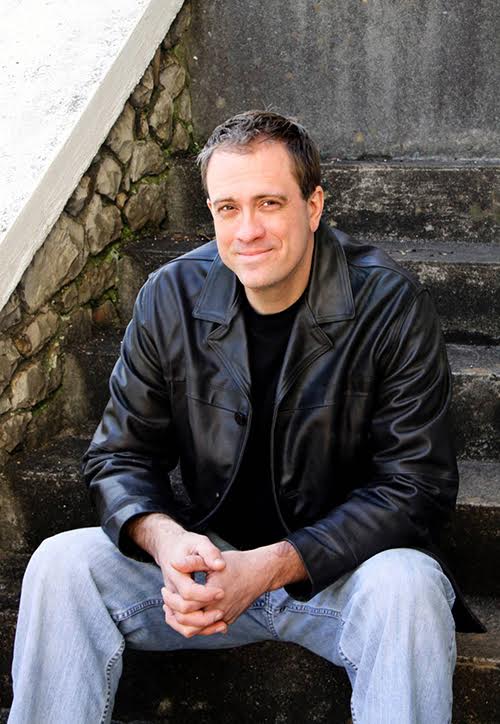
meg-bonney


Meg Bonney is a mom, writer, blogger, freelance writer and TV extraordinaire. Her YA fantasy novel Everly is due this November through Pandamoon publishing.


TAKE ONE…


clapper-board-152088_960_720


*Were you born and raised in Wisconsin?

Meg Bonney: Yes, I was! I work in Illinois and often get asked why I don’t just move there, but I am in love with Wisconsin. My town is right on Lake Michigan and the lakefront is gorgeous. I can’t imagine moving away from it.

It sounds like a nice place. I should have asked you for pictures!


*Which diva cat rules the household?

That would be my older cat, Sammy. He is the less dominate cat between my two kitties, but Sammy is the most demanding of his humans, for sure. He will meow at you and jump on the counters if he can see the bottom of his food dish. He is a snuggler but gets so mad when you move. He’s a total diva.

Wow. Sounds like a domineering feline-diva cat snuggler. Yikes!


cat in the clothes of the king on a red background


*What did you study in college?

I went to school for Paralegal studies. I work for a large company in the Mergers and Acquisitions legal department. It’s really fast paced and keeps me on my toes.

Oh cool! I enjoy legal stuff. We’re going to get along just fine. Sherrie, another blog-buddy of mine is also a paralegal. 


*Why did you pick to write YA Fantasy?

That’s always been what I gravitated towards as a reader and as a writer. I think that there is something more magical about those teen years before you are slammed with actual real life problems. It’s just a much more emotional time and I love writing characters at that age. And Fantasy is just plain fun. I take the firm stance that real life is boring. Fairies, goblins and magic just make anything more exciting.

I’ll completely affirm, that life is rather boring at times. Mundane even. That’s why being a writer is so much FUN! You can live an adventurous life over and over again. 


*Tell us about your upcoming Everly Trilogy

Everly is the story of Madison Rosewood and her quest to save her aunt. She and her best friend, Jason must travel to a hidden world called Everly where Aunt Ruth is taken in order to save her from a terrible fate. Once they get there, Madison comes to realize that Everly holds all of the answers she has been searching for about her family and her past. Book 1, which will be out later this year, introduces you to the world of Everly and the emotional struggles that Madison must face when she gets there. Book 2 and Book 3 will continue to chronicle her journey as she tries to figure out where she fits in and how to manage the devastating events of Book 1.

I like your premise! Sounds very interesting and adventurous. Love the name Everly. It gives it a nice fantastical feel.


text-x-read-me-md


*Can you give us a snippet about the protagonist?

Madison lives on a tiny Florida island with her icy, fitness trainer Aunt Ruth and her cousin. Madison is the star athlete on her school’s track team. Even though she is a gifted runner, she has no passion for it and yearns for something more. Her life goal has always been to find her birth parents and escape the constant work outs and self defense classes that her Aunt makes her participate in. She is withdrawn and snarky to everyone but her best friend and constant companion, Jason. She is outspoken and doesn’t care what anyone thinks about her. She is far from perfect but always tries hard to do right by the ones she loves.

YES. I feel like I’m already drawn into the story. Love the dynamics of the relationships here. I was just reflecting on this today actually. Our characters and the ones we love in our favorite books round out in dynamic relationships. Just think of Sherlock and Watson. Stories or movies that have a great sidekick are more enjoyable than the typical lone wolf hero. 


*Which medium do you enjoy more, reading or TV?

That’s so hard! I guess I would have to say reading because your imagination has no budget. But TV is great because of the community aspect, especially when you are watching a show live and you can discuss and theorize together. That’s very fun!

I can’t wait to ask you more questions since you’re a TV buff. I’ve been enjoying comparing and contrasting the two mediums a lot recently.  One of my favorite authors, K.M. Weiland, will be posting an analysis about the movie Avenger Civil War this week. If you’re so inclined, check out her site:  Helpingwritersbecomeauthors.com


meadow-677878_960_720-1


*Who are your favorite TV characters and what do you enjoy about them?

I love Buffy Summers from Buffy the Vampire Slayer. She is flawed yet strong and faces her destiny with determination even though her lot in life isn’t always fair. She is one of the greatest television characters ever. I also really like Bellamy Blake from The 100. He tries so hard to do the right thing but is tragically misguided and makes some pretty terrible decisions. I love characters that want to be the good guys but have a hard time aligning their goals with their morals.

Please don’t stone me, but I haven’t seen Buffy the Vampire Slayer yet. I’ve always been the slow one in the family. Go figure. BUT I LOVE BELLAMY and the entire 100 series. I was so hooked on the first two seasons!!!  Then I dropped off the map for some reason. 


“I love characters that want to be the good guys but have a hard time aligning their goals with their morals.”


*Who are your favorite fictional characters and what do you enjoy about them?

Hermione Granger. She goes from stuck up young girl to brilliant young woman over the course of the story and its captivating. Her journey is still one of my favorites. I also really like Batman. He is just so complex and the older I got, the more I grew to appreciate how messed up he really is. He is one of the most emotionally screwed up heroes out there and that makes him super interesting to me.

Hermione certainly sounds popular. Not acquainted with her either, but I have a feeling I will be pretty soon. Batman is once of the best characters ever crafted. Definitively a timeless classic that keeps coming back again and again. Even the whole story of Batman is classical. Gotham city with its backstory, villains, police department etc. Gotham the television series is also EPIC. Loved it until I fell off the map again. 

I got a kick out of your appreciation for Batman’s twisted emotional state. Because we can totally relate to these “screwed up” characters. That’s why I never could relate to Superman. He too *super* if you know what I mean. Even Clark Kent is essentially flawless. In Avengers Civil War they tried to make Captain America go through some sort of change, or arc, perhaps. But it utterly failed in my opinion. Simply due to the fact that he’s too flawless. Mind you I’m no expert, but he’s seems too confident and sure of himself to have flaws. Captain America is the representation of our idolization of old school heroism and is the epitome of American idealism. He stands for freedom, rights, liberty etc. But too perfect if you ask me.  


batman-1407484_960_720

*Which inspires you more TV or reading?

Reading is what made me want to write. I spent most of my childhood reading and it solidified my love of books and storytelling. TV inspires me in my writing when it comes to character development. There are certain things that a show can do subtly with characters that you maybe can’t do in a book. There is a lot more chance for subtle moments in TV that you may not get in a book simply due to the point of view of the story.

Yes, I find the contrast between these two mediums very fascinating. I also get inspired by TV. That’s actually how I got started writing!! I kept watching all these awesome shows with great characters until the light bulb finally went off in my head. Every time I’d watch something interesting I’d say to myself, write it yourself…write it yourself. So I did! Or, am still writing. But there are things we can do in books that you won’t get in a movie. Like fully develop a character the way you want without the time restraint of a movie. 


~Reading is a discount ticket to everywhere~ Mary Schmich


*Tell us about PureFandom.com.

PureFandom.com is all about the fans and their nerdy loves. I write recaps and reviews for them covering Supernatural, Agents of SHIELD and The 100. I also write all sorts of news items. They are a site dedicated to fandom and working with them is a blast!

Sounds like it. That would be so fun! I love Agents of SHIELD and the The 100. They’re wonderfully written and keep you on your toes the whole time. 


*Tell us about the hiddenremote.com and your contributions.

For Hidden Remote, I will be covering Supergirl! Supergirl is making the big move to the CW and I think it’s going to be an amazing change for them. I can’t wait to cover it! #girlpower

You go girl!! (Pun fully intended).  🙂


Superhero Child With Cityscape To Sunset


*When will your book be available?

My book will be available later this year! I am in the crazy editing stage and its been a blast so far. I love sharing stories with people and I can’t wait to share the world of Everly with you!

We can’t wait to read your story! I bet you’re an excellent storyteller. Looking forward to it. 


“Great stories happen to those who can tell them” -Ira Glass

THANKS MEG PLEASE COME AGAIN!

Connect with Meg!

Meg Bonney

@MegBonneyWriter

Blog

Pinterest

Benjamin Thomas

@thewritingtrain

http://www.thewritingtrain.com

Storytelling with the Master Steven James


THURSDAY SPECIAL EDITION


EVERYONE PLEASE WELCOME CRITICALLY ACCLAIMED NOVELIST STEVEN JAMES MY FAVORITE CRIME FICTION AUTHOR


steven-james


Steven James is a national bestselling novelist whose award-winning, pulse-pounding thrillers continue to gain wide critical acclaim and a growing fan base.


bargain-456002_960_720


NEW BOOK BY STEVEN JAMES


TROUBLESHOOTING YOUR NOVEL: Essential Techniques for Identifying and Solving Manuscript Problems


troubleshooting-your-novel


  • Paperback: 360 pages

  • Publisher: Writer’s Digest Books (September 20, 2016)

  • Language: English

  • ISBN-10: 1599639807

  • ISBN-13: 978-1599639802

  • Product Dimensions: 5.5 x 1 x 8.4 inches


FROM AMAZON


Take your story to the next level of excellence!

You’ve completed the first draft of your novel–now what? Chances are, it’s not perfect…at least not yet. In order to increase your chances of getting a literary agent, selling your manuscript to a  publisher, or garnering an audience for your self-published work, you need targeted, practical instruction on tackling the problem areas and weak spots in your story. You need Troubleshooting Your Novel.

In this hand-on, easy-to-use guide, award-winning author Steven James provides helpful techniques and checklists, timesaving tricks of the trade, and hundreds of questions for manuscript analysis and revision. You’ll learn how to:


  • ADJUST elements of story progression, from causality, tension, and setbacks to plot twists, climaxes, and endings.

  • DEVELOP authentic, riveting characters by exploring their attitudes, desires, beliefs, and more.

  • LEARN narrative techniques for elements such as dialogue, flashbacks, suspense, voice, subtext, and flow.

  • ENSURE reader engagement by aligning with their expectations, fulfilling promises, and instilling trust.

  • CHECK issues with context and continuity.

You owe your book more than just a polish and a proofread. Strengthen your story, prepare it for the marketplace, and make it the best it can be with Troubleshooting Your Novel.


NO ONE TELLS A STORY LIKE STEVEN JAMES- Benjamin Thomas


award-151615_960_720


1. What exactly is organic storytelling and can it be learned?
Many people I speak with are simply not interested in or very good at outlining a book. For all of us, there is another approach.
Organic writing is the process of allowing the story to emerge as you work on it rather than plotting it out or outlining it beforehand. It’s a more natural and intuitive way of approaching any art form than imposing predetermined constraints on it. As far as learning it, unfortunately there are few books that really teach it. Most offer a repackaging of the traditional approach of structure and plot. I offer one approach in my book  Story Trumps Structure: Who to Write Unforgettable Fiction by Breaking the Rules. 

This is awesome! Two words stick out to me in this statement. Emerge and organic. Trusting the story to emerge as we’re writing it is very intuitive.  


100 Percent Organic Food on Price Label Tag
2. In another interview someone asked how you keep track of plot because you’re an organic writer. You stated the following: “I’m a big believer in context determining content”   Can you expand on this? 

Within every scene you will find a variety of narrative forces pressing in on the narrative. For example, believability (the scene needs to remain believable within that story world), causality (every event has an impetus and an implication), escalation (tension continues to tighten), and pace, flow, voice, and so on. The context that precedes a scene will affect the emergence and affect of these forces. Really, any scene edited out of context will suffer in one of these areas. Writing great fiction does not consist of filling in the blanks, but in allowing the context and the unfolding promises and their payoff to inform the direction that the story takes.

I love it. Can’t wait to get more into this. 

“Writing great fiction does not consist of filling in the blanks, but in allowing the context and the unfolding promises and their payoff to inform the direction that the story takes.”-Steven James

3. What are the major facets of storytelling?

Beyond the ones I mentioned early would be implied and explicit promises. So, is you start a story by showing how perfect Anna’s home life is, with her doting husband and obedient children and daily yoga lessons, it’s an implied promise to readers that things are about to go very wrong very soon. You’re not telling readers this, but they understand the movement of a story and anticipate it. I strive to always give readers what they want or something better. And much of that comes from making big promises. And then keeping them.

This sounds simple yet profound. I totally agree with readers understanding the movement of the story. When all is well in the beginning there’s a certain amount of anticipation and suspense built up. Excellent.


What is your story Concept

4. What are the biggest hindrances to storytelling?

It’s lonely. Every novel I write requires at least a thousand hours of solitude. At times it’s hard to feel motivated, especially on a project that’s so large and daunting. So, many of the hindrances deal not with content or ideas, but with words and perseverance.

That’s amazing! A thousand hours of solitude rounds out to be 41.6 days steeped in the organic writing process. You just elicited the Wow factor.


Wow Surprised Word Astonished Surprising

“Every novel I write requires at least a thousand hours of solitude.” -Steven James

 5. What do you love most about telling stories?

Not going insane by keeping them caged up in my imagination. If I keep them chained up, they start looking for their one way of escape.

I can totally relate to this. This is the real escapism for authors. To gladly unleash our imagination to the world.


Here’s a short poem I couldn’t help but write after hearing about the writing process of Steven James. Here it goes…


*********

A THOUSAND FOR THE MASSES


He gave himself;
to the power of solitude, willingly.

A thousand hours
fiercely burned, consumed, only knew 

Him.

He gave himself so;
to multitudes  

of words, unsparingly.

Now the masses consume them.

 Benjamin Thomas

THANKS STEVEN!

CONNECT WITH STEVEN ON SOCIAL MEDIA

Amazon Author page

@readstevenjames

www.stevenjames.net

***************

READ STEVEN JAMES BOOKS

The Patrick Bowers Series

The Jevin Banks Series

The Blur Trilogy

Other Books

Thanks for ridin’ the Train!

train-1635038_960_720

Benjamin Thomas

@thewritingtrain

http://www.thewritingtrain.com

Watch “How To Use PR To Authentically Market Your Book With Janet Murray” on YouTube


Television Tuesday!


Sorry it’s a bit late…but here it is!

The talented Joanna Penn and Janet Murray talk using PR for book marketing. Enjoy!


anos-60-1300474_960_720


What did you come away with? Tell me in the comments!

Benjamin Thomas

@thewritingtrain

http://www.thewritingtrain.com

Interview with Story Coach, Author and Ghostwriter Kevin T. Johns


WELCOME TO THE TRAIN KEVIN!


kevin-t-johns-2


Kevin T. Johns is an author, writing coach, ghostwriter, and podcaster who is passionate about helping  writers.


call-center-1015274_960_720


Were you born and raised in Canada?

Yup. I’ve lived in and around Ottawa, Ontario, most of my life. I did a brief stint in Toronto after high school, but, for the most part, Ottawa has been my home.

I’ve yet to go to Canada. Can’t wait to tour the country!


canada-1343649_960_720


What sparked your love of literature?

Comic books and Stephen King. I wasn’t a big reader before the age of ten or eleven, but around then I started reading super hero comics and Stephen King books and it just took off from there.

I started with a comic bent too, but I didn’t start with novels until much later.  I should’ve asked you about your favorites.


comics-999504_960_720


After studying literature in college what 3 things have you come away with? (Besides debt)

1. An understanding that we all bring different lenses to our reading experiences, i.e. a book can be read with a feminist lens, a structural lens, a post-colonial lens. No one point of view is the “right” one. Each lens will provide different take-aways from a work of literature, all of which will be valid.

2. Literature (and art in general) plays a massive role in defining the culture we live in. We generally think of storytelling as escapism or just entertainment, when, in fact, it’s often key to formulating the world around us and how we understand it.

3. The analytical skill-sets used by literary scholars are applicable across a wide range of disciplines and situations, and are, therefore, well worth developing.

I love it. These 3 are great nuggets to chew on and appreciate. 


leave-364178_960_720


What drives you to help other writers?

I believe books and stories are profoundly important to our world and to people’s happiness in general. But books, and novels in particular, are exceptionally difficult to create. If I can help make the writing process a little bit easier for someone, I feel like I have a duty to do so. Shawn Coyne said something when I interviewed him for The Writing Coach podcast that I totally agree with: “When you learn a particular craft, it’s kind of your responsibility to share it so that we can take storytelling to a new level.” Sharing what you know, helping others as a teacher and a mentor, is how we all get better. So there’s a certain moral responsibility to sharing what I know about writing. I also just love working with writers. For whatever reason, it’s the thing that lights me up and makes me happy.

That’s awesome! I’m all about taking storytelling to the next level. It’s fun to work with writers!


~A brand is a story that is always being told- Scott Bedbury


Can you name up to 5 common problems you see most in writers?

1. Not writing (procrastinating, overthinking, delaying, giving-in to resistance,          avoiding doing the work, etc.)

2. Not having a regular writing schedule

3. Thinking software and tools will solve their problems

4. Taking themselves too seriously

5. Perfectionism

I’m definitely guilty of some of these. But if you don’t know the problem then you can’t fix it. 


The only mistake you can make is not asking for help.-Sandeep Jauhar


What are some of the ways that you help them?

The great thing about being a writing coach is that I can tailor my help to the individual writer’s situation. While there are certain common challenges every writer struggles with, the way each writers overcomes those challenges is totally unique to them. I don’t have a one-size- fits-all approach to helping authors. There is no secret answer or push-button solution. My job is to work with writers to explore options and find solutions that allow them to excel in their own special way.

I like the tailoring approach to helping writers. That’d be the most beneficial because everyone is so different.


help-1468281_960_720


Tell us about some of your own writings.

My novels The Page Turners and The Page Turners: Economy of Fear are young adult horror/sci-fi/fantasy mash-ups about a group of teenager who accidently unleash their favourite fictional villains into the real world.

Rocket Princess vs. Snaggletooth the Dragon is a children’s picture book for rebellious young ladies who want to be more than just another princess. It’s beautifully illustrated by Rich Lauzon.

Smash Fear and Write like a Pro is a short self-help manual for writers grappling with self-doubt.

The Novel Writer’s Blueprint: Five Steps to Creating and Completing Your First Book is a writing instructional book that helps aspiring authors craft their first novel.

I also blog regularly about writer’s craft.

AWESOME. I’d definitely like to check out some of your writings!  


the-page-turners


page-turners-2


smash-fear


rocket-princess


Who are some popular Canadian authors?

I certainly wouldn’t consider myself an expert on Canadian literature. My reading tastes are more focused on the cannon of “great literature” without much concern for the nationality of the author. There are, of course, certain Canadian authors everyone knows and reads like Margaret Atwood and Michael Ondaatje, but that’s not really my thing. I guess some of my favourite Canadian writers would be indie comic book guys from Toronto like Chester Brown, Joe Matt, and Seth.

Just wondered. I’ve been meeting so many writers from Canada I couldn’t help but ask. 


How can we sign up for your podcast?

On my podcast, The Writing Coach, I speak with all sorts of people who, like me, work with authors, be it editors, coaches, or book marketing experts. You can check out the full archive of past episodes and subscribe via iTunes right here.

Sweet. I listened to one these a while back and really enjoyed the production and audio quality.


street-1128882_960_720


Tell us about some of the services you provide.

My one-on- one coaching offers support, accountability, and expert advice to authors via weekly video-conference coaching sessions. Each week, I hop on a call with the writer and we dive deep into their writing, goals, and challenges.

My group program is similar to the one-on- one coaching, but takes place in a group context. I have an amazing collection of authors in the program right now who have created a wonderful community of support for one another.

I also have an online course, The Novel Writer’s Blueprint Master Class, which consists of video tutorials that walk aspiring authors through the entire process of writing a book, from idea creation all the way through to completed manuscript. I’ve set up a coupon code for your readers, so if they use the code WRITINGTRAIN at the checkout, they’ll get $200 off the course.

I also work as a ghostwriter. Successful entrepreneurs, coaches, and business people hire me to help write their self-help, business, or other non-fiction books and articles.

Sounds like a great deal that offers a lot of good services. You sound really busy! 


mark-804938_960_720


Are you currently working on a project or novel?

This fall I’m releasing my latest novel, M School. It’s an action thriller with an all-girl cast. It deals with issues of violence and mental health, and I’m super excited to share it with the world. Folks can get some free goodies if they join the book’s early notification list here.

I just signed up. Curious about your new novel!


M School by Kevin T. Johns


m-school


DUE THIS FALL!!


Favorite inspirational quotes.

I often come back to the Ernest Hemingway quote: “We are all apprentices in a craft where no one ever becomes a master.”


DON’T FORGET THIS MARVELOUS OPPORTUNITY

GET $200 OFF The Novel Writer’s Blueprint Master Class  when you use the coupon code WRITINGTRAIN at the checkout. 


THANK YOU KEVIN!


kevin-t-johns


CONNECT WITH KEVIN

@Kevin_T_Johns

Amazon Author page

Goodreads

www.kevintjohns.com


Benjamin Thomas

@thewritingtrain

http://www.thewritingtrain.com


Unlocking Worlds a Reading Companion by Sally Allen


WELCOME BACK TO FORENSIC LENSES


Featuring Sally Allen author of UNLOCKING WORLDS a reading companion for book lovers


unlocking-worlds


  • File Size: 1760 KB
  • Digital Length: 172 pages, Paperback 248 pages
  • Simultaneous Device Usage: Unlimited
  • Publisher: Griffins Wharf (November 11, 2015)
  • Publication Date: November 11, 2015
  • Sold by: Amazon Digital Services LLC
  • Language: English
  • ASIN: B017VOU7NC


WELCOME SALLY!


unnamed


Have you ever wondered what life is like through the eyes of another? To see what they see, know what they know, experience as they do? Do you yearn to participate in another’s inner life journey as they learn to navigate through it? Well, today we have an excellent resource in talented author and book lover, Sally Allen. Her book Unlocking Worlds, does exactly that. Unlock worlds in book after book with amazing protagonists, heroes and supporting cast. I’ve already added several (and counting) of these books to my Goodreads account. Which seems to be growing like kudzu on steroids at the moment.

I love books, and I also yearn to experience the the world view through the eyes of voracious readers, bookworms and book lovers. To get a taste of what they appreciate and how books have shaped them over the years. Whoohoo! Fun stuff! Unlocking Worlds will introduce you to the familiar and uncharted territories of lands waiting to be explored. To boldy go where no man has gone before…(sounds like Star Trek).


Now we get to enjoy an interview with Sally! Yippee!! Take it away Sally…


Who affected your reading habits as a child?

My family was my strongest influence. My parents restricted screen time (meaning I wasn’t allowed anywhere near screens from Monday through Friday), and my parents and older siblings were all readers. So from house rules to house habits, I learned to turn to books for entertainment. And I did!

We do the same thing at our house and our kids hate this. My childhood was quite the opposite with unrestricted screen time, yikes!  Wish I could’ve read more books back then. 


book-759873_960_720


Which stories, characters, or themes became part of your core values?

The two that first come to mind I read (and reread often) as a child: A Little Princess by Frances Hodgson Burnett and The All-of- a-Kind Family by Sydney Taylor. Both embodied the values my family instilled in me – community, family, empathy, and compassion – though in very different ways. They’re books I still think of, draw inspiration from, and enjoy rereading to this day.

These are very good values!  


quality-65060_960_720


How did your reading affect you in high school?

Reading was how I would relax and unwind. I remember spending countless hours lying on the floor of my room reading and rereading my favorite contemporary novels. High school was also when I first fell in love with classic literature Jane Austen, Charles Dickens, Mark Twain and learned to embrace a broader range of literary genres and styles.

I often hear these as sources of inspiration, especially Austen.


young-woman-635249_960_720


What did you appreciate about literature throughout college?

I most appreciated building on the close reading skills introduced in high school and learning how to research and discover more about the story behind a book. These highlighted how much we don’t understand and how much we have to learn. They taught me to have patience, to listen, and not to rush the judgment. Incidentally, all excellent life skills as well!

Reading is one thing, but learning the nuts and bolts behind it is another. Gleaning solid virtues such as patience, listening and understanding are excellent.


TRUE BEAUTY IS FOUND IN VIRTUE 

Who can find a virtuous woman for her price is far above rubies -Proverbs 31:10 


What was your goal in writing this particular book?

I wanted to share a way of reading for personal pleasure and enrichment. Reading preferences can be incredibly personal, driven by what we’re trying to figure out and by our personal experiences and preoccupations. I wanted to honor that and to show how books of all kinds can bring us both pleasure and growth, depending on how we approach them and why we’re drawn to them. I hope that readers will discover both books they’ve read and not read and that my book will inspire reflection and conversation.

Yes I’ve definitely appreciated reading your book and I’ve added many to Goodreads account already. Personally I believe we could benefit more from reflecting and conversing about what we’ve read and experienced. 


still-life-1037378_960_720


Tell us about your fascination with “aspects of wonder” from “Criticism” by Matthew Goulish. 

I encourage everyone to find and read Goulish’s beautiful essay! There is so much to treasure in and learn from it. What captured my imagination about “aspects of wonder” is the idea of being transported by beauty. In a way, it seems like it should be obvious that engaging with art is about transcendent moments. But that’s not always what happens in practice.

I’ll have to do some more digging to find it. Thanks for the reference!


…”it takes a keen mind and an open heart to recognize and value beauty.” I really enjoyed this quote and Ghoulish’s view of the critic changing, and not the work of art.

Thank you! Goulish’s view reminds me of the saying (I believe it’s Carl Jung’s), “You are what you do.” How we approach and engage with art can mirror how we approach and engage with the world around us. If we enter into an art experience with an openness and sense of possibility, it can change what we allow ourselves to get out of it. And that approach to books can translate into how we approach the world around us as well. So how we read matters a great deal.

I find this very fascinating. How we approach and engage with art mirroring how we engage with the world around us. EPIC!


watercolor-portrait-1050714_960_720


How do you feel about the current 5 star rating system for books?

I am not a fan. Reading is such a rich, transformative, dimensional experience. To reduce a book to five stars has a way of draining the complexity, life, and beauty out of it for me.

Wow. I love your statement on this. It provides a totally different mindset when it comes to books. 


knowledge-1052011_960_720


If you had to choose another time period in which to live in, which would you choose?

So many of the books I love were written in the 19th century. I’m also fascinated by ancient Greek literature and by all that we can’t know about that time. It would be interesting to visit and experience everyday life in either of these times. Though I must admit, I’m quite happy to read about the past from my comfortable perch in the 21st century!

Hah! True enough. Greek is pretty fascinating, love the language. The 19th century sounds cool…but I’d rather read about it. 


How does reading shape and transform us?

Reading allows us to see the world through another set of eyes and from another position in space and time. It introduces us to new ideas and new ways of looking at the world. Research is beginning to help us understand how reading experiences can rewire our brains. Having felt changed by my experience of books – Boris Pasternak’s Doctor Zhivago, Toni Morrison’s Beloved, and Zadie Smith’s White Teeth come to mind – I can believe it!

I’m very intrigued how reading affects our brain development and experience. Recent books have touched on this using cognitive science. It’s affects are amazing!


road-sign-1280254_960_720


Tell us about your favorite literary Mom.

The first one I thought of is Marmee from Little Women because she’s such a steady, comforting presence. But I also adore Miranda’s mom in When You Reach Me by Rebecca Stead. She’s quirky, gives great advice, challenges Miranda to think harder and be kinder, and she is 100 percent devoted as a parent.

Moms are the BEST! Like you said, steady and a comforting presence. That’s a mom. I’ll have to add these books to my ever-growing TBR list.


minion-moms


Do you have a favorite father figure?

My favorite literary father figure is Joe Gargery from Great Expectations. He’s kind, loving, patient, loyal, forgiving. My favorite literary dad is Atticus Finch in To Kill a Mockingbird. He never talks down to his children, and he embodies empathy, even when it is most difficult (and therefore most valuable).

Splendid. Empathy can be rather challenging at times, but it’s definitely worth it.


If you had to pick a protagonist to marry who would it be?

I love Hamish Macbeth from M. C. Beaton’s murder mystery series. He has the right priorities: the desire for a peaceful life (somewhat ironic, since he’s constantly having to solve murders!) and deep care for his community. Another favorite is Obinze from Chimamanda Ngozi Adichie’s Americanah. He’s patient, loyal, and an empathetic listener, (and he’s a reader!).

This was a fun one! Hamish Macbeth and Obinze. By the way, thanks for recommending Americanah. It sounds like a very moving story. 


i-beg-your-pardon-927744_960_720


If you had to pick a hero for president, who are your top 3 choices?

I agree with Albus Dumbledore that those who want power are probably the least to be trusted with it. So my choices would lean towards those who have neither expressed a desire for power nor pursued it. My three picks will stick with the Harry Potter theme: Kingsley Shacklebolt’s focus, discretion, and principles put him at the top of my list. I would also vote for Hermione Granger, who is highly rational, clever, and has a strong sense of justice. Finally, Mr. Weasley seems happy to sacrifice prestige for doing the right thing. He would get my vote.

Great picks! Love your philosophy on this. Sounds like it would make a great book, or perhaps fan fiction?


white-house-754766_960_720


If you were a damsel in distress, who would you call on to rescue you?

Hopefully, I would be able to rescue myself. 🙂 But in a pinch, Hermione would be a good person to have in my corner.

Being rescued is more fun 🙂  I’m noticing a pattern here. If Hermione would become president, then rescued you, that would be a blockbuster.


superman-1070457_960_720


Do you have any other books in the works?

I’ve been working on an idea for a book on classic literature. It’s still in the beginning stages, so we’ll see where it takes me.

Stay tuned!

Absolutely. A book on the classics sounds great. 


THANKS SALLY!


Sally Allen is an award-winning author who holds a PhD in English Education from New York University, with an emphasis in writing and rhetoric, and an MA in English Language and Literature. She has taught writing and literature at New York University and Fairfield University, and is the recipient of New York University’s Willy Gorrissen Award for Dedication and Skill in the Academic Development of Student Writing. Currently, Allen is a faculty member at Post University where she teaches literature, writing, and communications. She is the founder of Books, Ink at HamletHub, a website dedicated to Connecticut books news, where her writing has earned her three Connecticut Press Club awards.

Unlocking Worlds (Griffins Wharf, 2015) can be purchased from Amazon

and other booksellers nationwide. More information about Sally Allen can be

found at www.sallyallenbooks.com, Facebook, Twitter, Instagram, and Goodreads.


Benjamin Thomas

@thewritingtrain

http://www.thewritingtrain.com


Let’s Talk Fantasy with Author Joshua Robertson


LETS TALK FANTASY

WITH TALENTED AUTHOR JOSHUA ROBERTSON


joshua-robertson


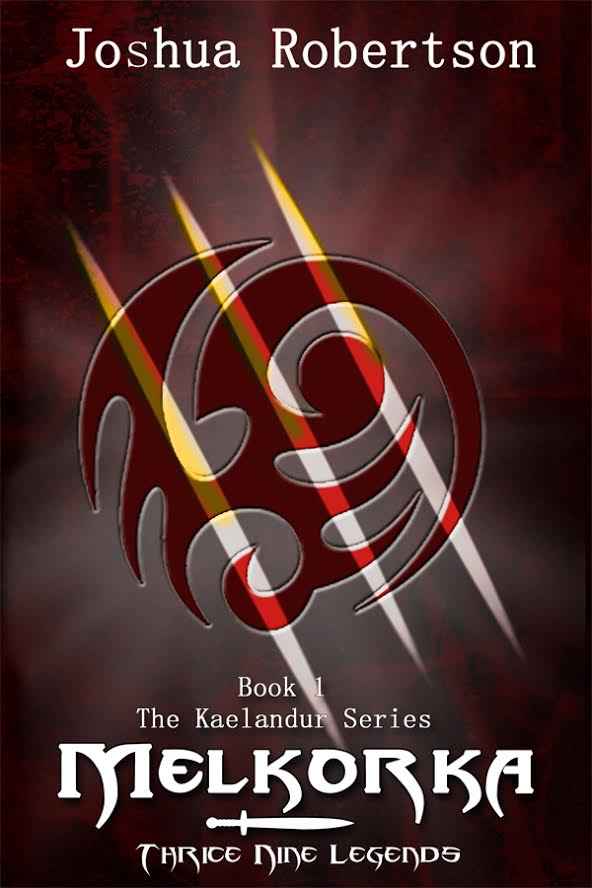
Joshua Robertson was born in Kingman, Kansas on May 23, 1984. A graduate of Norwich High School, Robertson attended Wichita State University where he received his Masters in Social Work with minors in Psychology and Sociology. His bestselling novel, Melkorka, the first in The Kaelandur Series, was released in 2015. Known most for his Thrice Nine Legends Saga, Robertson enjoys an ever-expanding and extremely loyal following of readers. He counts R.A. Salvatore and J.R.R. Tolkien among his literary influences.

www.crimsonedgepress.com
www.facebook.com/AuthorJoshuaRobertson
@robertsonwrites


WELCOME!


hand-1592412_960_720


THE KAELANDUR SERIES


melkorka


Melkorka, the first in The Kaelandur Series


dyndaer


Dyndaer, the second in the Kaelandur Series


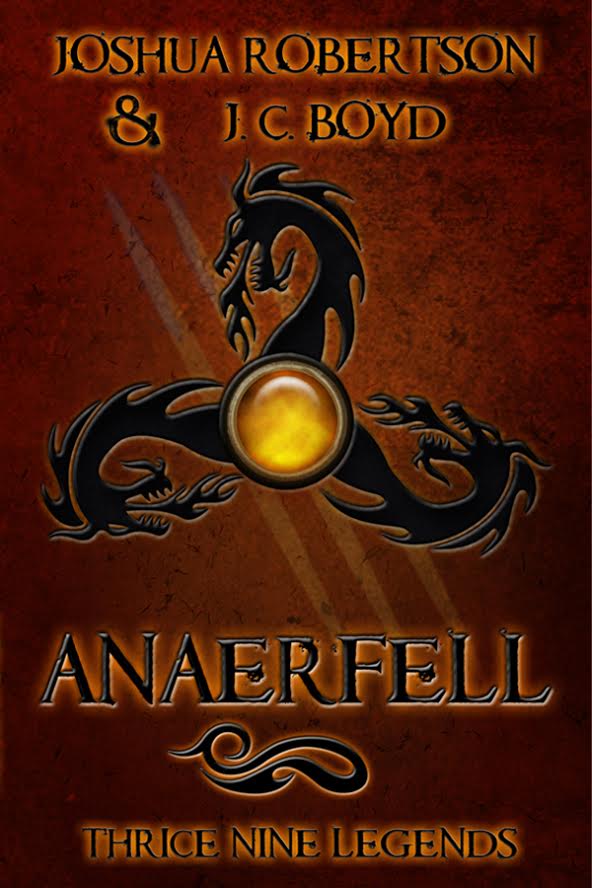
anaerfell


Anaerfell


*What is your definition of fantasy?
My definition of fantasy literature does not drift too far from the typical explanation. Fantasy must have supernatural elements in the theme, setting, or plot of the story. Some writers like to include magic, and others may have a simple make-believe worlds to play inside. Regardless, I think fantasy should take a reader on an adventure they cannot experience anywhere else.
They always say simplicity is bliss. I love this definition. 
man-1567255_960_720
*What are your favorite elements that make a great fantasy book?
Likely, the same thing as most good novels, but most of all, it must have dynamic characters. Fantasy has shown promise with the rise of books that drift away from the dichotomy of good and evil, and really explore the motivations of the protagonist and antagonist. In this way, we see multi-faced characters who have mixed elements of right and wrong, which makes a much more believable story…in a fantastical world.
Yes, I’m hearing this more and more. We tend to be drawn more to characters that seem to blur the lines between good and evil. 
photoshop-manipulation-1566435_960_720
*How were you influenced by RA Salvatore & JRR Tolkien? 
Tolkien I started reading around the age of 13 or 14, and continued re-reading through the course of my high school career. We know how impressionable the mind of a teenager can be…and I was a sponge for his words, characters, and philosophy. A couple years after reading Tolkien, I delved into many other great writers, such as Salvatore. The man’s description of battles were so real, I often finished the book with a serious sense of awe. Nowadays, after having a few interactions with Salvatore, I also admire his kindness, straightforwardness, and humanness.
That’s awesome. I love hearing about this, the impression that authors make upon readers in their early years. I guess you never know how your words might affect others!
old-books-1511507_960_720
*Does fantasy have to include magic to be successful?
Absolutely not. I have read many great stories without a hint of magic that were exceptional and stuck with me. I think the quality of a book is measured by the impression it has on your life after you have put it down. Without a doubt, you can achieve this without having magic included, even in fantasy literature.
Wonderful! My project is somewhat of a science fiction fantasy mashup, but without magic. I have several fantastical elements within it though. 
*What are your favorite creatures?
Strangely enough, even as a Tolkien fan, I am not a huge fan of Tolkien creatures. In fact, the only time I really delve into elves, dwarves, etc., is when I am reading Tolkien, or playing a good ole’ game of Dungeons and Dragons. If I had to choose a favorite fantasy creature on the spot, it would be a dryad. Though, I have never considered writing a story focusing on their kind. I don’t think I could do it justice.
I’ve often thought of crafting my own creatures rather than going along with the norm. Never even heard of a dryad. Trolls are pretty cool too.
monster-1524001_960_720
*Tell us about Anaerfell
Anaerfell is a dark fantasy tale about two brothers who are trapped beneath the ambitions of their father. Drast and Tyran were raised in a harsh home, offering them little grace and even less love. As a result, you see two grown men who are haunted by their own psychological and emotional demons, struggling to make the ‘right’ decisions. The story unfolds as their father sends them on a journey to kill the God of the Dead in hopes it will grant him immortality.
I absolutely adore the names that you come up with in your books. In fact, my first impression when reading your work was, THIS IS FANTASY.  It’s almost the same as test driving a car for the first time. As soon as you step into the vehicle; grab the steering wheel, start the engine and pull out onto the road that it’s the car for you. Hey, it’s fantasy on wheels!
book-1012275_960_720
*What is the connection between Anaerfell & the Kaelandur Series?
Excellent question. Anaerfell takes place 80 years prior to the events in Melkorka, the first of the Kaelandur Series. The book, although a standalone, is written to be a prelude to the series, giving breadth to why the characters in the Kaelandur Series are facing the deadly threats of the Netherworld.
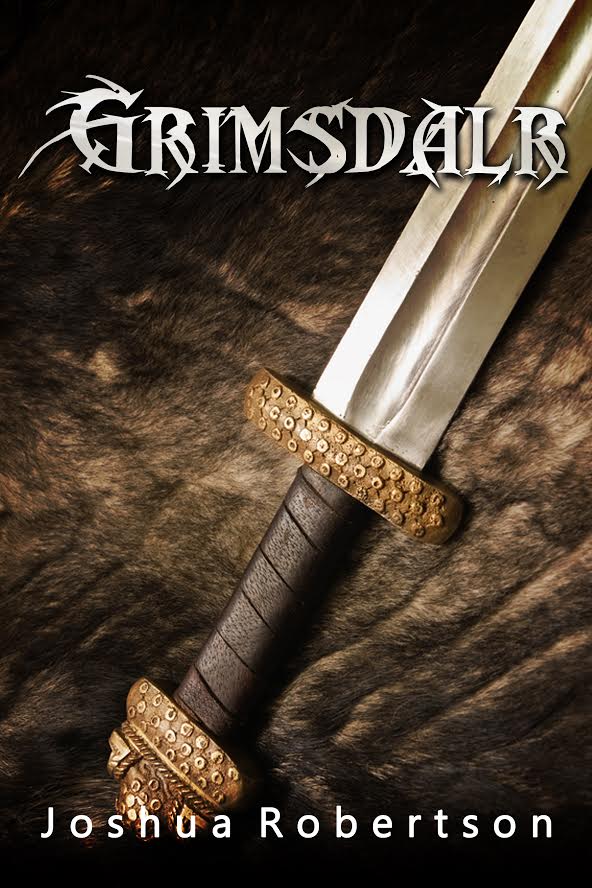
*What is Grimsdalr about?
Grimsdalr is a short story meant to highlight how hubris is regarded in modern society when compared to the norms of olden times. The story is a rewritten, 30-minute read masking the opening pages of Beowulf keeping much of the same tone and language of the original tale.
Grimsdalr is another excellent name by the way….Just read this and the ending was very striking and totally wasn’t what I was expecting. Stellar writing that reminded me of Beowulf. LOVE BEOWULF. That’s my boy!
grimsdalr

Grimsdalr

*Who are your favorite characters and what do you appreciate about them? 
I have answered this question often, and I think my answer continues to strike folks as strange. But my favorite character in my series is the antagonist, Falmagon. I appreciate his commitment to his beliefs and his intent to make the world a better place, regardless of whether others support his cause. Of course, I also have a special place in my heart for my cliche’d, all-knowing, often-drunk wizard, Dorofej. Many have called him the Gandalf of the Kaelandur Series.
I can totally relate to this. I love my antagonists and evil henchmen! BROUHAHAHA! In Transformers, Megatron was my favorite. In Star Wars, it was Darth Vader. In my WIP there’s several antagonists that are my FAVS. Here are a few:
Lord Gracious, twin brother of Brynn Talegan. 
Barag, Lord of the Dark Vein of Evil
Pronvis, General in the Dark Vein of Evil
Grand Morticus, High Priest of the Dark Vein of Evil
Grane, the Unmerciful Death Lord
*What are your top 3 favorite weapons?
I am a simple man. Give me a quarterstaff, a good set of throwing knives, and a longbow.
Simple enough. 
archer-299498_960_720
*What top 5 books would you recommend?
The Crown of Stone Trilogy by C.L. Schneider
Dolor and Shadow by Angela B. Chrysler
Wolves of the Dawn by William Sarabande
The Silmarillion by J.R.R. Tolkien
Prince of Thorns by Mark Lawrence
Thanks for the references!
*What else do you have coming down the pike?
I am currently finishing up Blood and Bile with my co-writer, J.C. Boyd. This dark fantasy tale will be introducing his ancient world, beginning with giants walking with mammoths in the northern lands battling dark spirits.In addition, I should be finishing Maharia, the third and final installment of the Kaelandur Series, and ready for release by April 2017.
Thanks so much for having me for an interview! These questions were excellently crafted.
Awesome! Thanks for coming on the train.


thanks-1183287_960_720


Benjamin Thomas

@thewritingtrain

http://www.thewritingtrain.com

Immersed in the Criminal Mind with Author Katherine Ramsland, PH.D.


This is the hauntingly true story of the infamous Wichita Kansas Serial Killer, BTK. Katherine Ramsland, PH.D. has in depth work into the minds of one of the most notorious extreme offenders in modern history.


*PLEASE NOTE THAT ALL PROCEEDS OF THIS BOOK WILL GO TO THE VICTIMS FAMILIES*


Get it now on Amazon


Confession


Available now on Amazon: CONFESSION


From Katherine Ramsland’s Amazon Author page:

Katherine Ramsland began her career as a writer with Prism of the Night: A Biography of Anne Rice. She had a bestseller with The Vampire Companion. Since then, she has published 59 books and over 1,000 articles, reviews and short stories. From ghosts to vampires to serial killers, she has taken on a variety of dark subjects.

She holds graduate degrees in forensic psychology, clinical psychology, criminal justice, and philosophy. Currently, she teaches forensic psychology and criminal justice at DeSales University. Her books include The Forensic Psychology of Criminal Minds, The Human Predator: A Historical Chronicle of Serial Murder and Forensic Investigation, Inside the Minds of Serial Killers, Inside the Minds of Sexual Predators, and Inside the Minds of Mass Murderers.

She speaks internationally about forensic psychology, forensic science, and serial murder, and has appeared on numerous documentaries, as well as such programs as The Today Show, 20/20, 48 Hours, NPR, Coast to Coast, Montel Williams, Larry King Live and E! True Hollywood. She spent 5 years assisting “BTK” Killer Dennis Rader write his autobiography, and has started a supernatural fiction series with The Ripper Letter.


WELCOME KATHERINE


search-1019904_960_720


*In your recent book, The Mind of a Murderer, and now Confession, both take the offender’s point of view. Can you tell us the significance of this as opposed to other approaches?

Actually, The Mind of a Murderer places each POV of an extreme offender in the frame of the theorist or clinician who interviewed him or her. It describes a dozen cases from the past century of mental health experts who devoted time to an extended case analysis through interview. This gave me an appreciation of the benefits of this approach, which can yield items that arise only with a deepening sense of the subject. Because it’s clinical and not salacious, the trained listener can structure the questions for maximum advantage to the discipline of criminology. You get a good sense of the layers of behavior – especially the manipulative behavior – as well as being able to ask a lot of questions that might occur to you along the way, so you can develop a more complex portrait. Within that, you might find motives that fail to fit stereotypes. An important aspect is to identify outliers, so that we can recognize the limits of our current theories and improve them. With Rader in Confession, at first, there was distance, as he did not know me well but he respected my credentials. As he found that it was easy to talk about ordinary things, he revealed more. There came an element of trust and familiarity that one can achieve only with numerous contacts. In addition, if you catch someone in an inconsistency or deception, you have their statements on tape or in writing. More important, though, is the ability to stay focused on a subject, pressing for clarity and detail. This is what we call qualitative research, which provides an open-ended richness to an interview that standardized tests or superficial questioning just cannot achieve. It’s not about having offenders just talk about whatever they want. Because the experts have background in research and/or trained expertise, they will structure the interviews to draw out helpful insights. There’s a bit of a research filter, but not much.

I appreciate this approach very much as it applies to the the discipline of criminology. Hopefully this will give us an inside view of the criminal mind and expose the limits of our understanding of serial killers. I’ve read another book entitled, Inside the Mind of BTK by former legendary FBI profiler John Douglas, who writes from a completely different approach. But the approach taken in Confession provides a certain mindset drawing out rich details. 


Forensic evidence word cloud


*How do you immerse yourself in the mind of an extreme offender such as Dennis Rader? 

I’m not sure if you’re asking about my method or my ability to endure it. My method was to read everything available, including five years of correspondence from a previous person who had contacted him. Then I spent five years corresponding with him and talking with him on the phone. Prison visits, I discovered, were of little value, aside from socializing. The real work came from his writing and drawings. How I was able to get deeply into this project relies on the ability to keep my goals in mind and adopt a clinical perspective. I have studied extreme offenders for many years and have written quite a few other books on them, so I had the ability to 1) listen to Rader describe his murders without reacting emotionally, and 2) place what he was saying in the context of my prior research. Many writers will tell you that immersion is truly the best way to experience and express yourself on any subject. Quite a few of my projects have been immersive. In this way, you shed your personal frame and evolve toward other perspectives. You learn to think like someone else. My first experience of this was jarring, but eventually I fully embraced it.

Wow. This was truly an immersive project. Having to read 5 years of previous correspondence, spend another 5 corresponding, and then conclude with a professional analysis is nothing short of amazing.


Brain activity


*What did you learn about the perception of this particular serial killer? 

Dennis Rader has written hundreds of pages and drawn explicit pictures from his fantasy life. He provided a rare opportunity to get inside the mind of an organized, predatory serial killer who designed his killing career on specific role models, real and fictional. Because he offered specific details, I could add some experience. For example, when he described how he had selected stamps to use on his cat-and-mouse letters, I considered this when I looked at a wall of stamps. It helped me to briefly think like a predator. In turn, this helps me to stay safe and teach others to do so. I expected that working so closely with someone like Rader would have an impact on my thinking and theorizing. I have deepened my description of certain aspects of the criminal mind. Rader and I discussed things like living compartmentalized, but watching the act of it up close is quite an experience. There were walls that kept him sealed inside specific narratives, and nothing I asked or said made him more self-reflective about them. However, this behavior interested me, too. Cops have said I didn’t confront him enough to get to the “truth,” but there are many types of truths. I wasn’t interrogating him.

People like Rader think differently. As Rader puts it, “Hunting and prowling became a habit, much like drugs. You learn to cover up, hide those times in your normal life and develop a different set of life frames.” We need to accept that reality has layers and we don’t all share the same perception of it.

Yes, I read about his development from his childhood, and it definitely sounds like he had some abnormalities that may have affected his brain development. Especially his hidden erotic fantasies. It seems that they secretly grew within him until he actively sought out to reproduce what he saw in his own head.


child-1154951_960_720


*How is Rader unique in the realm of other serial killers?

It’s difficult to answer this question succinctly, since I spent an entire book exploring it. But I can say this: Many people have assumptions about serial killers and they expected Rader to fit the mold. In some ways he did, but in other ways he didn’t. Not many serial killers start out trying to copy role models. Not many compartmentalize successfully for three decades, especially when addiction is part of the compulsion. Few carry on a successful social life, with family responsibilities and a job, while also planning murder. Those who are conversant with their paraphilias won’t necessarily offer up details for analysis the way Rader did. Many have abusive backgrounds, but he did not. He kept an extraordinary amount of “hidey-holes” for all of his fantasy paraphernalia. And he had contrived a way to be Jack the Ripper and the Boston Strangler all rolled into one – although he didn’t quite pull off his ultimate plan.

He definitely breaks the mold of assumption. This was definitely an eyeopener!


*In a separate interview, you made this statement: “I am most fascinated with Rader’s description of  “cubing” (his word for the more clumsy academic phrase, compartmentalization). He talks about how he developed “life frames,” but more interesting for me was bumping up against these boundaries whenever I asked difficult questions.” Is this “cubing” or compartmentalization unique to Rader, or do others exhibit this trait?

Living with several psychological compartments is common to anyone who attempts to have separate and contradictory centers of morality or meaning. It’s difficult to kill and also dictate that extreme violence on TV is wrong (as Rader does) unless you can move comfortably between these diverse points of view. It’s not multiple personality disorder. It’s more like being an actor, taking on different personas. With these people, the various roles are part of their lives. With psychopathic tendencies, the reduced sense of empathy and the lack of remorse assist the process. But compartmentalizing isn’t limited to serial killers, or even to criminals. It’s not difficult to spot it in many public figures, from sports stars to CEOs to politicians.

On one hand this is completely mind boggling, but on the other it’s very fascinating. A lot of people are intrigued by crime because they don’t understand the “why” or the motivations behind it. Although we may never understand the reasons or varied obscurities of crime, we should analyze its expression.  In this book, you let Rader express himself according to a structured clinical perspective. He also kept copious amounts of written material about his fantasies, crimes and drawings which gave us an intrinsic view of his mindset. 


crime-scene-1240780_960_720


*Do you think this “cubing” mindset contributed to his criminal behavior? Or why in his own mind would he separate his lifestyles in the way that he did?

Cubing is a pretty common activity, and it evolves gradually. It’s not a calculated adoption of a lifestyle. It’s part of the development of a fantasy life, because it’s about enjoying oneself in secrecy. The more deviant one’s fantasies are, the more likely one will develop a cube for it. In this way, the brain develops neural pathways to support it, so that it’s easier to go in and out, as well as easier to keep separate. You develop a persona that is acceptable to the people around you, but you go into your fantasy world when you want to fully indulge. I would say any novelist knows this experience, and probably other creative types. The more they accommodate the secret life, the more natural it feels, and if it’s more rewarding than ordinary life, it will become their ultimate retreat. Then, when they act out and actually commit a murder to accommodate their fantasy, they decide if it’s all it was cracked up to be. If so, and they get away with it, they will do it again. Rader describes how he kept believing there was a line he wouldn’t cross, but then he did. It was like being on a boat that was floating away. He kept thinking he wouldn’t float so far that he couldn’t get back to shore, but then he did. And he accommodated it, thereby evolving toward a new sense of himself. What he believed did not match his reality. His victims paid the price for that. Then his life changed and kept changing, but he had no moral base against which to measure himself. He just kept doing what felt good to him. He recreated himself.


I’m very curious about how his brain would’ve developed abnormally according to his dark fantasies. He probaby was hard wired completely for his intense fantasy world. Brain plasticity or neuroplasticity, has great potential for change throughout life according to normal life experiences. As a child develops over time their brain is shaped according to what they learn and practice producing neural pathways typical of any human being. But in this case, sounds like his brain developed atypically for something dark and abnormal. From what I’ve read, even way before he acted out his killings on others, he practiced binding on animals and even on himself. 

One other confusing thing is that he had no moral base against which to measure himself. He was the president of his church and an active member so he must’ve possessed some morals. Second, he was a strict city compliance officer who would go out and measure people’s lawns with a ruler. Third, he served in the U.S. military for some length of time. Fourth, he was a cub scout leader. Fifth, he was a wannabe cop who was addicted to reading detective magazines. The guy definitely had morals, well, at least in that “cube” of his life. But when it came to his “fantasy cubed life” he used a twisted sense of morality to carry out his crimes. Actually, his sense morality in this part of his life was entirely based on fictional and real serial killers. He would berate and measure himself if he didn’t’ conduct his crimes correctly or lose control. 


skull-1529065_960_720


*Was he incapable of distinguishing between his “normal” life from his own criminal fantasies?

No, he was capable of understanding the difference, but the reward of his darker life had more weight than his “social obligations.” It felt more alive and exciting; it held the possibility of fame. His ordinary life did not. Some offenders are much more focused on immediate reward than on moral duty and prosocial behavior. This does not mean they are mentally impaired. For Rader, it became an addiction, but he didn’t lose sight of the fact that murder was wrong and illegal. After all, he went regularly to church!

This is fascinating. That he was completely capable of understanding the difference between the two, yet the reward of the darker life dominated all sense of social obligation, or moral duty of law. Now I’m theorizing how this goes back to his lifelong practice of paraphilia would’ve affected his brain development and neural pathways. Any drug addiction is a neurochemical nightmare on any human body. According to WebMD, “drug addiction is a brain disease because the abuse of drugs leads to changes in the structure and function of the brain”.  Unfortunately his drug of choice was a complex binding and torturing fantasy of human beings.


smoking-1418483_960_720


*Why do killers seem to inspire one another? Is it fame, power, recognition?

Only some killers are inspired by others, and for a diversity of reasons. Healthcare serial killers, for example, want to learn how to use medications they hadn’t thought of. Among copycat mass murderers, some get ideas or methods that they hadn’t considered, while others find courage or confidence from seeing another carry out what they fantasize about doing. For some, the act of another is a trigger. Something similar can be said for serial killers who view others as role models or who think that this is the best road to fame. Rader got ideas, was inspired, fed his fantasies, acquired an identity, and felt compelled to become one of the elite. He had several reasons to copy others, but primarily it was for the erotic rush. But I’ve seen some killers who merely seek fame. There isn’t a way to generalize, because each has his or her own trajectory toward violence.

I think I understand some parts of his life, but seeking to become one of the “elite” is beyond me. We talked about cubing or compartmentalization. It seems that all his “cubes” were just a stage for the most dominant one, his fantasy. The addiction of the erotic rush was there, but so was ambition to become one of the greatest. To me, this is just an extension of his fantasy. 


*Why would he, or anyone, seek to be famous for serial murder? 

For some people, fame is highly intoxicating. Some people seek it through legitimate means, others through crime. Those who seek it through crime either believe it’s the only way they can be famous or they decide that crime is the most exciting avenue to fame. They see it in news coverage and they want to be described like that, too. Some even identify an actor to play them in a movie about their crimes.

Fame can be intoxicating. We can see that in the corruption of politics, sports, business and even our own lives. But how someone would seek it through crime is unfathomable. Then to decide that it’s the most exciting avenue to fame is startling. Fame can be a drug or an addiction. 


desert-444833_960_720


*How will the findings of this book affect criminal or forensic psychology?

It won’t affect these disciplines as a whole, but hopefully, I have added some information to a subfield of knowledge about extreme offenders. I would like to believe that I have elicited greater appreciation for the extended, in-person case study, but I know that few people have the time to devote to something like this. I also hope I have made a case for keeping our notions about serial violence open-ended. People who study human beings in terms of probabilities or trends tend to focus on categories – what I call a cookie-cutter approach. This encourages a “we know all we need to know” mentality. I prefer to ponder individuals, to see how the particular details of their lives braided together toward violence. I think we need to stay open to the element of surprise and uniqueness.

I believe your last statement wholeheartedly. I would prefer to ponder the individual as well, then apply it contextually.


*What did you experience in writing this?

Across the course of five years, I had many experiences, although I never had second thoughts about pursuing it. At first, it felt somewhat daunting, although I had already written two biographies and other books. Also, I knew that some serial killers can be vulgar, crude, and demanding, but Rader never was. Over time, we got to know each other and the project took shape. When I saw that he was really trying, this became a more significant project for my research. As I was wrapping up, it seemed like this could be the most intense and psychologically deep book that I’ve ever written. I didn’t know if it would actually turn out well, but during the final six months, I was pretty sure it would cap so much of what I had done before it. The final result feels dense and comprehensive, but I don’t think what I did is complete, so there’s an experience of anticipating something more.

I really appreicate the time, effort and dedication you’ve committed to this project. You’re a consummate professional. Thumbs up.


thumb-1429327_960_720


*How has this book affected your understanding of a serial killer?

I have deepened my understanding of certain aspects, such as the academic notion of compartmentalizing. But also, I have experienced pressure to force Rader into a “type,” to make him fit cultural and academic notions about serial killers. Colleagues had certain expectations, such as that he had to have been abused as a child, which made me think about the fact that we sometimes act as if we already have all the answers. This is a terrible attitude for researchers. It means we’ve closed off possibility and there’s no reason to keep exploring. When we’re dealing with humans, we can’t be so certain. Each person brings something from his own life story, and rather than try to force Rader into a pre-established mold to suit colleagues, I let his story be the way he saw it. Maybe it’s not all true and maybe some things remain hidden, but the behavior that went into the telling of it had its own revelations. Having once taught existentialism at Rutgers University and having studied phenomenology at Duquesne University, it was nice to be reminded to bracket my personal bias and let the raw material be what it was.

This is much appreciated! You’re highly regarded for expertise and experience. You’re honesty is also notable. Thank you so much for all your hard work.


Follow Katherine Ramsland:

On GOODREADS

On her website Katherine Ramsland

On her blog Psychology Today


*****************


OTHER BOOKS BY KATHERINE RAMSLAND
My Forensic Books

Psych Books

Paranormal

Other Books


thank-701985_960_720


Benjamin Thomas

@thewritingtrain

http://www.thewritingtrain.com


The Story of Dave Johnston Family man and Author


MEET DAVE JOHNSTON 

AUTHOR OF THE ATOMIC NUMBER SIXTY

And the Sixty Minute Read Series


DaveJohnson


WELCOME DAVE!


sixtypublishing


Atomic Number Sixty (Sixty Minute Reads Book 1) 


*Where are you from?
Sheffield, UK

I’m not going to lie. I had to look this one up on the map. I’ve definitely heard of it, but couldn’t place it in my head. Think I need a memory upgrade. 

map-1019896_960_720

*What exactly is the 60 minute read series?

When I was considering starting my quest to write a book, I first thought about the books that I like reading: sharp, punchy, to the point. No fluff. No fuss. No long, dreary, padded paragraphs. Since my kids arrived, time is also a premium, so short bursts of reading is usually the norm. And thus, amongst all my pooled ideas, the Sixty Minute Reads series was born. Roughly 300 words per chapter, each with its own cliffhanger drawing the reader on, all anchoring in real time around an event or location, with flashbacks and revelations converging to that final, sixtieth minute.

I love the concept of this. Very fascinating and innovative. You certainly deserve a high five.

Fans: Men High Five Each Other

*Do you write full time?

I don’t write full time. I’m not even sure I write part time! I just write as and when the mood takes me. I’m very much a flitter in life.

Hah! I can totally relate to this one.

board-928392_960_720

*Tell us about the protagonist in your new book.

Holly Holloway is hard to understand. She’s strong, she’s sassy, yet in certain situations she acts weak, vulnerable, and well, human. Perhaps she is difficult to like, seems a bit of a bitch, but maybe all things become clear in the end.

Vulnerability is always a keeper in crafting a protagonist. Readers tend to relate to that more than anything.

*Is this a stand alone book or beginning of a new series?

It is very much a series. I love my concept, there’s so much scope.

That’s awesome. Sounds like it definitely has potential. 

trust-1287750_960_720

*What genre do you mainly write in? 

Young Adult: this is to be a series of Thrillers, but I have also written a YA Adventure novel (yet to be published)

YA definitely has a lot of market appeal. I love to read in this genre too!

What inspired you to become a writer?

I used to read books a lot as a child. I was really encouraged by my family, and would consume book after book, even walking to the bus stop banging into lampposts. Writing seemed to come naturally later in life.

That’s awesome. I cracked up at this. Picturing you banging into a lamppost while reading was hilarious.

lampost-893131_960_720

What’s your GOAL  in becoming a writer?

I think I have already reached my goal: to become a published author. Perhaps my new goal is to become a multiple published author.

Goal achieved. Multiple publications sounds very desirable. 

What 3 things have hindered you from completing your projects? (CONFLICT)

Time, desire, imagination.

Time: I work full time, have a young family that I love spending all my free time with, and climb as a hobby when I can.

Desire: I find it hard to WANT to edit my books. The thought of endlessly correcting my work seems to eternally stretch before me, so I put it off and off.

Imagination: My own imagination runs away with itself, such that when Draft 1 is complete, I am already off and thinking about the next book or books or series of books.

Ah, yes. These are the three heavyweights. Time, desire and imagination. 

sumo-156787_960_720

What keeps you motivated in achieving your dream? (DESIRE)

To get that first book in paperback. To see it on our bookshelf at home. To think that one day my children will pick it up and read it and know that their Daddy created it. That it might inspire and spark their own imagination and dreams and loves. Motivation, got it in spades mate.

I guess that would be pretty surreal seeing your own book on the shelf.

What’s your ANTAGONIST? What’s in the way?

Only my self. The wandering, writers mind. If only I could type as fast as my brain can think.

This wandering mind can be quite a problem sometimes. 

no-1513027_960_720

Have you ever wanted to give up your dream? If so, why?

I’ve given up plenty of times. When the rejection letters came through from an industry that is only interested in the “painting by numbers” writing approach. When I had 10 chapters left to write and I couldn’t be bothered. When my laptop ran out of battery. Any excuse really.

Well, I glad to see your book online!

Why do writers give up, quit, or never complete their projects?

From a personal point, I would say that human modesty plays a large part. Imagine writing down all your thoughts and ideas, and then letting somebody else read them. Or worse, your friends, family, the guy next to you at work. It’s weird, right? But you get over it. You get supported. You realise you’re being silly and life is like that sometimes.

I suppose we have to develop very thick skin to survive. 

signs-1172211_960_720

What would you say to a struggling writer who’s given up?

Why give up? With self publishing such an easy, free, accessible ride these days, you can publish to the world, and then learn from your mistakes. No need to tell anybody you know, maybe even write under a pen name, but put it out there. Don’t let all that hard work go to waste. Lots of people won’t like it, but if you’re proud of it, then there will be people out there who will be too. Don’t write for everybody, write for yourself.

I tried to beat my reading addiction……Worst two minutes of my life. -Unknown

If a book is well written, I always find it too short. -Jane Austen

Whatever you do keep writing…..


Benjamin Thomas

@thewritingtrain

http://www.thewritingtrain.com

The Reading Voracity of Author Rayne Hall


Welcome Back to the reading series


FORENSIC LENSES


Bringing you the best of the reading experience. 


There are those who read. Then there’s the avid readers. Beyond that, you have the chronic bookworms and voracious readers who set themselves apart from the pack. After reading this article, you’ll discover a person who is altogether in another realm when it comes to reading voracity. 


Contact lenses


Forensic Lenses seeks to discover the rich reading experience accumulated deep in the wells of the human heart. Taking an investigative and exploratory approach, case by case, I hope you’ll join me in this exciting journey.


used books at the bookshop


BOOKS, BOOKS, AND MORE BOOKS!


EVERYBODY PLEASE WELCOME 

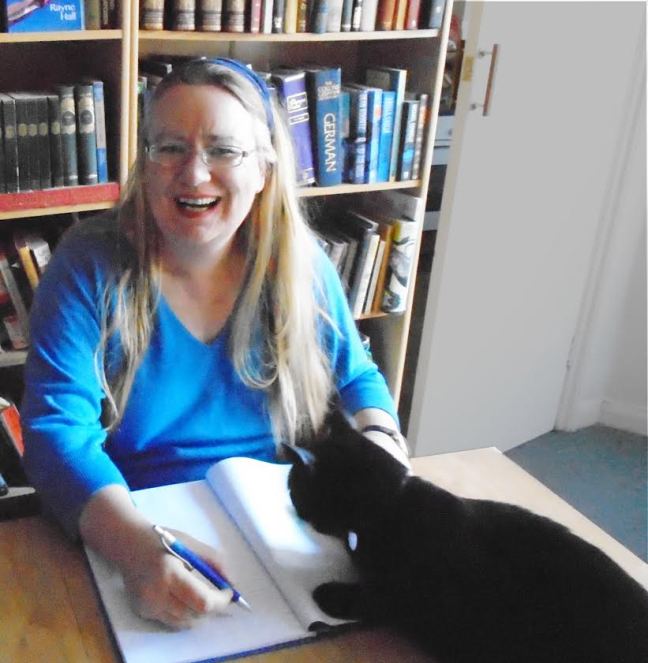
RAYNE HALL

and Sulu the Cat


Rayne Hall


Rayne Hall is a Publishing guide, writing coach, the bestselling author of the Writer’s Craft guides who has three decades of experience in the publishing industry as a publishing manager, editorial assistant, magazine editor, investigative journalist, production editor, literary agent, and publishing consultant. WHEW. But the most impressive feat to me is that…


SHE READS 500 BOOKS A YEAR!!!


Jubiläum


Yes, you read that correctly. 


LET US BEGIN OUR JOURNEY INTO THE MIND OF ONE OF THE MOST VORACIOUS READERS ALIVE


Who influenced you in your early reading habits as a child?

I learnt to read early. At the age of 4, I startled my parents by reading a political newspaper headline out loud. They were aghast, because they had not taught me to read. I had somehow worked out the meaning of letters myself, though I can’t remember how I did it.

From then on, I devoured books, starting with small-sized illustrated children’s books from the ‘Pixi’ series which was popular in Germany at the time. Soon I grew bored and read bigger books, borrowed from my elder sister who encouraged me. There were a lot of religious books in our home, mostly gifts from a great-uncle who was a catholic priest, and they included some really exciting children’s stories. I also remember a book filled with stories about the lives and deaths of martyrs. That was scary stuff – it seemed that the reward for a pious life was to get crucified, burnt alive or eaten by lions!

When I finally went to school to be taught to read, I was of course bored. After reading about kings, robbers, goblins and pirates, the school book with pages of nothing but ‘i I i’ and ‘l l l’ held no interest. Even in year two, when we finally got a textbook with stories, I was frustrated, because I’d read the whole book on the first day which left nothing new for the rest of the year.

This is rather AMAZING. You seemed to devour books even before you were officially taught to read! You’re probably the most voracious reader yet. You’re voracity is off the charts!


Portrait of a very hungry, wild and angry young boy, holding and


*Who were your childhood favorite authors?

You may not have heard of them, because they’re German authors: Hans Baumann, Karl May, Anna Müller-Tannewitz. Erich Kästner. I was also a fan of Enid Blyton and devoured every book available in German translation. Once a week I took the bus into town and borrowed as many library books as the library card allowed, which was never enough. Eventually, I’d read every book in the library’s children’s section.

Now that’s an amazing feat. Reading EVERY book in the library’s children’s section. That’s completely mind-boggling.  You just elicited the WOW factor. 


Wow Surprised Word Astonished Surprising


*Tell us how you came to read around 500 books a year

I read very, very fast.

It’s not just your appetite for books, but also the pace of reading that’s stunning. 


superhero-534120_960_720


READING AT SUPERSONIC VORACITY LEVELS 


*That comes down to about 10 books per week and 41 per month. That’s a lot of books. Are a lot of them forgettable? Which one’s touch you the most and why? 

I easily read a book a day, often more. Sometimes I don’t read for a day or two, but that’s rare.

I remember most of them, although not consciously. I often buy or borrow a book which feels familiar after a few pages and after a couple of chapters it’s clear that I’ve already read it many years ago.

If a book is forgettable, I won’t waste time reading anything by that author again. I wish Amazon had a feature for marking authors I don’t want to read again. On the other hand, if I loved a book, I immediately look for more works by that author.

You must have an awesome memory! Can I borrow some? There must be a longstanding history in the memory banks. I can only imagine.


quote-1342706_960_720


*In your motivation to read so many books, are you searching for something particular?

I seek the pleasure of reading, of experiencing different worlds, meeting new people, learning new things, going on adventures without putting myself in danger. Sometimes I look for excitement, sometimes for something to smile about, sometimes for information, inspiration or advice.

These are all so lovely. It’s amazing how we can experience it all through the written word. Exciting!


*What’s your method? Do you aim for a certain amount books per week or month?

Not at all. That would make reading a duty.

Well said. 


*Do you have an outlet after accumulating so many experiences reading?

I’m not sure I understand your question. I always mean to review all the books I read, but I rarely get round to this, because I’m always busy reading the next book.

 There’s a wealth of experience just waiting to be mined. I would love to pick your brain sometime. 


brain-770044_960_720


AT THE SCENE OF THE CRIME…..


*You’re a very experienced reader who must have a keen eye. What are your 5 biggest pet peeves?

Let me think.

1. Characters who sigh and grunt all the time, and heave deep breaths to steady themselves on every page.

2. Over-use of ‘began to’ and ‘started to’.

3. Gratuitous sex scenes.

4. Head-hopping/point- of-view violations, i.e. when I’m reading the story and experiencing the events from inside the head of one of the characters, and then suddenly I’m in another character’s head. That jolts me out of the story.

5. Writers obviously natural talent but haven’t honed their skill to the full level and instead used self-publishing as a short-cut before they were great. Had they continued learning their craft and revising their works, their books could have been great.

These are all very good. Everyone’s pet peeves are different but some are more common than others. Head hopping or POV hopping is definitely one of the more frequent ones. 


police-850054_960_720


*How has reading affected your career in writing, editing and publishing?

I’ve become very aware of how important the free sample pages are. As a reader, I always download several samples, glance at the beginning, and decide which one I want to buy. Some books are appallingly written, and I won’t buy them. But I’ve also come across many books where the free sample had no real content. The sample was taken up by legal disclaimers, forewords, quotes, lists of the author’s other works, review excerpts – but no taste of the actual book. So I didn’t buy them. This has taught me to arrange the front matter in away that leads the reader straight into the main content.

I spot common mistakes, and see what kind of mistakes writers make most. These range from lay/lie confusions to early flashbacks. Knowing what mistakes writers make is useful when I guide writers in my classes, books and consultations.

I know which beginnings are overused, for example, the main character travelling to a destination, the main character waking up and readying himself for the day, the main character selecting a dress to wear for the special event. This knowledge helps me avoid those beginnings in my fiction, and it enables me to advise other writers.

It’s also the other way round: my writing and editing work influences how I read. I see flaws in books more than a ‘normal’ reader does. If I wasn’t a writer and editor myself, I would probably still perceive those flaws, but I couldn’t put a finger on what exactly is wrong, I would just sense vaguely that ‘I don’t like this’.

You must have a very keen eyes.


biometrics-154660_960_720


*As a person who has read probably thousands of books, what has changed over the years?

Are you asking about books, or about me? I’ll answer both. What’s changed about me is that I’ve become less patient. I used to read at least two chapters before giving up on a book I didn’t like. Now I don’t even read two pages. Two paragraphs is enough to tell me whether a book is worth reading or not. The free sample downloads are great for this. I guess I’ve become blasé in my assessment what books are worth reading.

What’s changed about books over the years? A lot! Thanks to ebooks and the indie publishing revolution, far more books are getting published, and a much wider choice is available for any taste. Books have become available catering to very specific niches. There’s more freedom for readers to choose, and more freedom for writers to write what they want. All this is wonderful.

The downside of this is that a lot of sub-standard stuff gets published. New authors don’t realise that their book isn’t good enough yet, and some people hire ghostwriters for ridiculously low rates to churn out book after book. But I don’t think this is a big problem, because readers can choose what they want to read, thanks to the ‘look inside’ and ‘download sample’ functions.

There’s a lot more interactions between readers and authors. In part that’s because in many cases, middlemen have been removed from the publishing process, and in part its thanks to easy online communications. In the past, if I wanted to write to an author, I had to write a snail mail letter c/o the publisher, who would forward it to the agent, who would forward it to the author, and if I was lucky, the author would reply. Most of the time, I didn’t get a reply, because the author was long dead (and I didn’t realise that), because the publisher hadn’t bothered to forward my letter (withholding fan mail was common practice) or because the author couldn’t be bothered – and I didn’t know which was the case. Nowadays, I simply search the author online, send them a message via their website, leave a comment on their blog or write a quick tweet. And most of the time, I get a reply. That’s wonderful. Often there’s a dialogue between authors and readers that wasn’t possible in the past.

Book buying has become easier. I remember how long I had to wait to get a book I wanted. I had to go to a book shop, order the book, wait for days or weeks for it to arrive… and then it was often a disappointment.

Now I click ‘download sample’, dip into those pages, and if I like it, I click ‘buy now’ and have the book within seconds.

Regarding book content, I’ve noticed that there’s a lot more sex in fiction. Erotic fiction has become easily available in a wide range of subcategories catering to every taste. It think the emergence of ebooks enabled that, because readers can buy the book they want without exposing their interest, and they can read it on their Kindles without anyone seeing. I remember as a twenty-year- old I wanted to read some erotic fiction. I waited until I went on a journey by railway, then at the destination station, where nobody knew me, I scanned the shelf for such titles and had to make a rapid choice without test-reading. Hot and blushing with embarrassment, I took my selection to the cashier. Back at home, I wrapped the books to hide the covers, less any visitors would see the titles. When I finally got to reading them, they were often disgusting stuff I didn’t like, because of the narrow available range and the hurried decisions. These days, I could browse at leisure, pick a book I really wanted to read, and read it discreetly on my Kindle. I’m no longer interested in reading erotica – I choose not to – but I think it’s good that other adults have the freedom to read erotica if they choose. And they don’t even have go through the mortifying process of taking the books to a cashier.

Sex has also become more common in other genres – so common that sometimes it’s difficult to find a book without sex in it. Personally, I prefer erotic tension to erotic actions, and when characters have sex, I prefer it if they keep their bedroom doors closed. I get annoyed when sex scenes are forced on me. I remember wanting to read some good urban fantasy novel and every one of them had gratuitous sex. Of course, the latest development is the rise of the ‘chaste’ book. In almost any genre, it’s possible to search for ‘chaste’ or ‘clean read’ books. That’s part of the diversity and increased choice, and is good.

In crime fiction – cosy mysteries and thrillers – specific real locations have come to play a much bigger role than they used to. Whole series are set in Edinburgh or in Colorado or wherever, often the place where the author lives. This local flavour has become part of the pleasure of reading crime fiction.

In non-fiction, I’ve observed that advice books are increasingly based on the author’s experiences, and include first-person sections. This makes the books more authentic and personal.

This is great info indeed, thanks!


change-671376_960_720


*As an experienced reader, in your opinion, what makes a good book?

My answer would be different depending on what kind of book. A good book is a book that gives me what I want – and what I want differs from day to day and genre to genre.


I love this answer. It’s so succinct and to the point. 

 
THANK YOU RAYNE
 

************


A good book is a book that gives me what I want – and what I want differs from day to day and genre to genre.- Rayne Hall


************


Connect with Rayne Hall! 

@RayneHallraynehall.comcontact

Writer’s Craft Series

Amazon Author Page

Suscribe to mailing list!


HERE’S A SAMPLE OF SOME OF HER BOOKS


unnamed (12)


unnamed (23)


unnamed


unnamed (21)


unnamed (22)


unnamed (20)


unnamed (19)


unnamed (18)


unnamed (17)


unnamed (16)


unnamed (15)


unnamed (9)


unnamed (1)


___________________________________________________________


Reading is a basic tool in the living of a good life. -Mortimer Adler


************


Reading a good book is living life dangerously- Benjamin Thomas


************


_____________________________________________________________


COME AND JOIN US AGAIN ON THE TRAIN!


Benjamin Thomas

@thewritingtrain

http://www.thewritingtrain.com


Author Kevin Cady Introduces the Warren Files Trilogy


Everyone please welcome KEVIN CADY


Kevin Cady


Kevin is the author of the Warren Files Trilogy, a high school teacher from Colorado Springs who loves climbing in the mountains.


BOOK ONE OF THE WARREN FILES by Kevin Cady


A Solitary Awakening


A Solitary Awakening: Book One of the Warren Files


Where are you originally from?

I’m originally from Oxford Ohio, a red-bricked college town tucked in the southwest corner of Ohio.

YAY Ohio! Woohoo!  I’m from Ohio and currently in the Dayton area. I’ll be going to visit a family in Oxford this weekend! 


Ohio wooden sign with agriculture landscape on background


Have you always wanted to be a writer?

I have certainly not always wanted to be a writer, but writing was the one subject in school I deemed tolerable. I wasn’t a great student and wasn’t a great reader. Writing novels came to me as an adult because of the ideas I want to consider and convey. With how I work, writing makes sense, because it helps me understand, and ultimately manage the world I’m in.

I can certainly relate to this. Writing didn’t really take off until late adulthood. Everyone’s path is a little different, but that’s the beauty of it.


The right destination


Which authors have influenced you the most in your career?

Writers, and writing which has influenced me is a tough question to answer, because I don’t necessarily want my work lined up beside those people (half lighthearted and joking). But there are certainly writers who have influenced me, and writers whose work I greatly admire. I hope I can someday stack up. The people I admire (I feel) have written their own way, in their own style. I think Chuck Palahniuk, author of Lullaby and Fight Club (among others) is a perfect example of someone, who isn’t writing in the same genre as I am, but is a perfect example of someone who creates amazing narratives in their own way, almost as his own genre. When you pick up a Palahniuk book, you know who wrote it. I feel the same about a man named William Sloane, who published a couple of Cosmic Horror novels in the 1930’s, light years ahead of his time in my opinion. These two have surely influenced my writing, but a shortlist of others would include… Mark Danielewski, Steven Hall, and Alex Garland.

I haven’t heard of any of these but I always enjoy learning of new authors. 


What attracted you to crime writing?

I love crime writing because it generally centers around the darkness that lives inside people. I think this darkness is something interesting, and the idea that people do horrible things for a slew of reasons can be an exciting combination. What happens if we agree with motive but disagree with action? It can create unique moral dilemmas, and it can push big-picture questions out into the world.

YES. I love it. It’s quite fascinating isn’t it? The darkness of the human condition, legal grey areas and the impossibility of moral dilemmas are all too intriguing.


Moral dilemma ahead


Can you give us an introduction to Elijah Warren and the Warren Files Trilogy?

Elijah Warren is a man who lives for his job. He breaths and sleeps the FBI, and it might seem due to his lack of personal life. In fact, he lives the FBI to avoid a personal life. He’s cast off relationships and (since a tragic accident as a child) unofficially vowed to focus on the Bureau’s issues. When he is forced to work alongside Aurelia Blanc, an erudite detective whose vast intelligence isn’t superseded by her beauty, a twinge of something finds him affected, and when they’re pushed to find the esoteric, “Poetic Murderer,” the quandary becomes all the more real.

In the first book our protagonists chase the Poetic Murderer across the United States. They’re twisted and turned around, and rarely are gaining evidence it doesn’t appear they were set up to find. The first book focuses greatly on why things happen, and sets up the key pieces for the remaining two books.

The second book, Crooked Principles, takes the (now former) detectives to remote Grizzly, Alaska, where they’re snowed in and forced to track a killer who has killed a person per year for twelve years, leaving the town’s population at less than a hundred. It’s a very personal story, and as the detectives feel more and more stranded, more and more paranoid, their relationships are put to the test. New relationships pop up and affect theirs. Elijah Warren starts to feel like maybe he’s out of his depth, and comes ever closer to losing Aurelia as they search for Grizzly’s Secret.

The final book brings characters from both novels together, and the narrative becomes bigger than all they’ve done. Unbeknownst to them, their prior actions have begun a series of events that will come to  affect every human in the world. There is still a serial killer, one indicative of the Poetic Murderer’s work, but that’s not the greatest challenge this time. The protagonists are separated and pulled all across the globe, chasing a new enemy that threatens civilization at its core, and has for nearly a century. Elijah and Aurelia and their collective crew are the ones that must intervene.

AWESOME! I can’t wait to see how the story develops. 


detective-158249_960_720


When can we expect the next installment of the series?

The second book in the Warren Files Trilogy, Crooked Principles, is in the final stage of revision, and it’ll be available next summer!

AWESOME. It already sounds intriguing. 


Who are your favorite characters or protagonists, or sleuths?

One of my favorite characters ever written is Lisbeth Salander from the Millennium Series, by Stieg Larson. I was immediately captivated by her terse impassiveness, in combination with her unique technological skills. It made her immediately intriguing, and I wanted to know all I could about her. I finished all his books because I needed to understand Lisbeth and her story.

Another character I loved reading about was Hannibal Lector. His intelligence, way of thinking, and ultimately his relatability made him an unforgettable antagonist.

Wow. These are all noteworthy. I love how you felt compelled to understand Lisbeth Salander and her story. I don’t think an author could ask for more from a reader. Crafting an unforgettable antagonist is one of my hidden ambitions. BROUHAHAHAHA.


Child reading a book, wearing large glasses


What’s it like being a teacher?

Being a teacher, and the experience of it, is something I could have never foreseen. As mentioned, I didn’t like school, and didn’t do that well. I try to teach in an engaging way, one that pushes all students to critically think. I try to teach the power of thinking, and this year I’m getting to do so through a series of novels I’ve chosen. It is a senior level English class, and it is a unique year because I’ve taught these kids 6 years in a row.

I came to Atlas Preparatory when it was just beginning as a school, and each year we have added a grade (we started in 5 th ) . I’ve taught my students various courses, but I’ve moved up with them each year, and this year I’ll finally shake their hands at graduation.

It must be rewarding to see them grow and develop before they’re sent off into the world. 


hands-1445472_960_720


You think you’ll ever write a YA series?

I’m certainly not opposed to a YA series, but I don’t know if it’d be anytime soon. I love some of the newer YA series because they’re able to engage thinking toward high-level societal issues, and so, if I was to write a YA novel or series, it would have to be deliberately tackling some sort of worldly dilemma. I would want people to be engaged by and love the story, but I’d want a greater purpose for it.

Well put. I can tell you put a lot of thought behind your writing. Excellent.


Favorite quotes?

Do the right thing. (It’s the motto I give my students.) We don’t know what we don’t know.


**************


THANKS KEVIN 

Your time is much appreciated!


**************


“Remember that guy that gave up? Neither does anybody else.” -Unknown


____________________________________________________


“Why not go out on a limb? That’s where the fruit is.” -Mark Twain


____________________________________________________


The book to read is not the one that thinks for you, but the one which makes you think. – Harper Lee


____________________________________________________


Over and out….


man-303962_960_720


JOIN US NEXT TIME

On the train….


Benjamin Thomas

@thewritingtrain

http://www.thewritingtrain.com