
On The Train
with Angela Ackerman
We have a very special post today, with bestselling co-author of mutiple blockbuster thesauri Angela Ackerman.
WELCOME ANGELA
We’re so pleased to have you with us today!

Angela Ackerman is a writing coach, international speaker, and co-author of the bestselling book, The Emotion Thesaurus: a Writer’s Guide to Character Expression, as well as four others including the newly minted Urban Setting and Rural Setting Thesaurus duo. Her books are available in five languages, are sourced by US universities, and are used by novelists, screenwriters, editors, and psychologists around the world. Angela is also the co-founder of the popular site, Writers Helping Writers, as well as One Stop for Writers, an innovative online library built to help writers elevate their storytelling.
You can also connect with her on Twitter: @AngelaAckerman
I’m so glad to have at least one half of the dynamic duo of Angela Ackerman and Becca Puglisi. These two are a completely awesome pair and deserve a splendid title. Therefore, by the power vested in me, I deem thee Champions of Inspiration and Thesauri Queens! WAHOO! HIP HIP HOORAY!
And if you haven’t heard already, Becca & Angela are the masterminds behind the game-changing Positive and Negative Trait Thesauruses, as well as the Emotional Thesaurus.


CONGRATULATIONS
The life of every man is a diary in which he means to write one story, and writes another. ~J.M. Barrie
Hi Angela,
You and Becca have two wonderful setting books coming out soon, June 13th I believe. Can’t wait to read them. YUM. So let’s talk settings shall we?
Please don’t stone me, but I’ve never been to Canada. Hopefully sometime soon though. Especially since I keep meeting great people from Canada. (and I drink Tim Horton’s coffee)
*You live close to Calgary, Alberta; what’s it like living there? I bet it’s UBER GORGEOUS. Do you have any pictures of the Canadian Rockies to woo us with?
I won’t lie—it’s very beautiful. I am close to the mountains, and a well-known place called Banff, which is one of the most sought out natural areas in the world. Becca recently came up (from New York) as we were teaching a workshop together, and the first thing we did when her feet hit the ground was drive 45 minutes to Banff.
That sounds pretty inticing. I’ll have to follow suit.
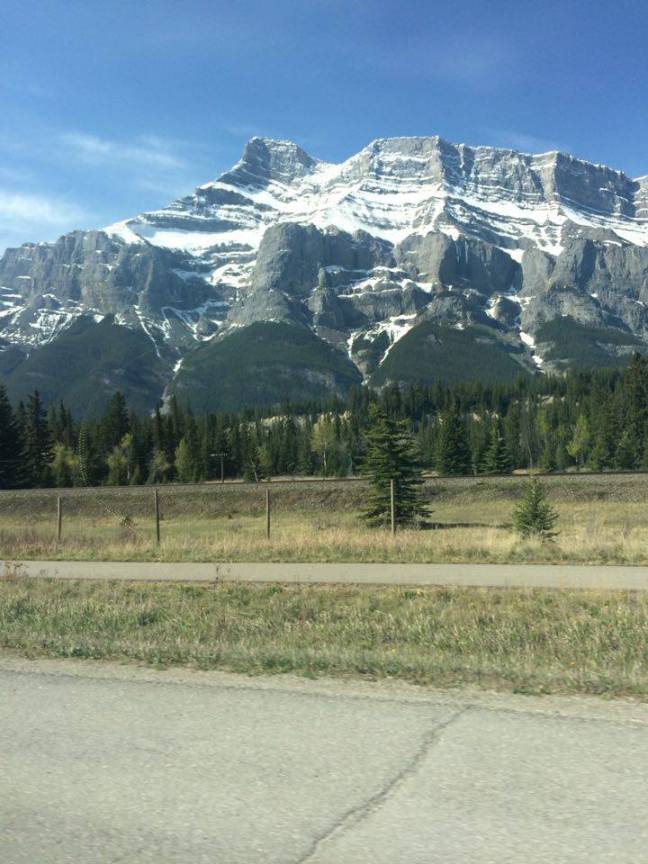
This is absolutely breathtaking.

Looks like the mountains are right in your backyard practically!
See below for a list of their publications.
The Positive Trait Thesaurus: A Writer’s Guide to Character Attributes
The Negative Trait Thesaurus: A Writer’s Guide to Character Flaws
The Emotion Thesaurus : A Writer’s Guide to Character Expression
Emotion Amplifiers Kindle edition
The Rural Setting Thesaurus: A Writer’s Guide to Personal and Natural places. Add this publication to your Goodreads account.
The Urban Setting Thesaurus: A Writer’s Guide to City Spaces. Add this publication to your Goodreads
*Tell us about your new setting books and how they can enrich our writing.
This pair of books I think will surprise people, because so many writers really don’t peel back the curtain on setting and all it can do. Most think of setting as a stage, a place that is necessary for a scene’s action to unfold, the anchor for readers. They sprinkle in a few sensory details to help the reader picture it and then focus the storytelling lens on the action. But setting is story glue. It lends powers to all other elements: helps to characterize the story’s cast, adds dimension to plot and character growth through challenges and conflict, evokes mood, steers emotion through emotional triggers and symbolism, and even allows writers a way to deliver critical backstory in a non-dumpy way. Honestly, choosing the right setting for each scene is akin to creating magic, so learning how to use setting to its fullest may be one of the smartest things a writer can do to improve their storytelling.
But I guess that might not fully answer your question. Bare bones, these books show writers how to use the setting to elevate a story as mentioned above, plus list the sights, smells, sounds, tastes, and textures for 225 setting a characters might visit, spark ideas on how to generate natural conflict in the setting, and give descriptive examples of each one using different techniques. Most of the book is set up in list format, and each setting location has two pages of sensory detail and information. This allows writers to find the description they need that fits perfectly with their story and then quickly get right back to writing.
You guys are the best in the business, honestly, at what you do. We give honor to whom honor is due. I have all your books, yet there’s unplumbed depths waiting to be discovered.
Hone your skills with the Urban Setting Thesaurus.

Unearth the secret of mastering the Rural Setting detail.
I have to say, I’m licking my chops here waiting for these books to come out. In order to write or utilize setting to its fullest potential we need a KEEN NOSE. For detail, discerment and skill. The skill is in the balancing affect. Knowing when, how, and how much of the setting to enrich our stories with.

*Can you tell us about the adventures you and Becca experienced in researching settings? I’M SURE YOU HAD MANY ADVENTURES LOL!
Yes we did. Becca has taken quite a few road trips to check out marinas, lighthouses, schools, and racetracks. I hung around some seedier areas to get sensory detail on alleys and underpasses, toured a jail cell, watched half a dozen videos on (ugh) taxidermy, and was arrested so I could get the sensory experience of being handcuffed in the back of a police car. Thankfully it wasn’t a real arrest because my family set the whole thing up, but it FELT pretty real, let me tell you!
I like how you casually weaved in getting arrested. I bet that was quite a sensory experience. Adventurous indeed!
*Where physically did you have to go in order to obtain the necessary sensory feedback?
Most of the locations we have in our books we physically visited. Some we couldn’t. It’s hard to get into a psychiatric ward, for example—they aren’t big on letting you tour a place like that. Or a funeral home, or a slaughterhouse. In these cases we watched a lot of you tube videos, did a lot of googling, and often talked to people who worked in these settings. But other places—a cruise ship, casino, a fire hall, ancient ruins, pastures, rainforests, orchards, salvage yards—these we visited. At the fire hall I got to try on all the firefighter gear, and man, talk about heavy!
Cool. You should’ve taken a picture! Sounds like it was a pretty thorough job. My dad was actually a fireman his whole career.
*Where emotionally did you have to go to tune in to the settings?
Good question. It often depended on the setting, and what sort of emotions were naturally evoked. Sometimes we had to distance ourselves. To get detail on slaughterhouses and pastures, we watched a lot of videos that were disturbing and graphic—animal slaughter processes, factory farming, animal cruelty, things like that. We had to try and focus as much as possible on the details, not what was happening, to get these entries right.
Wow. That’s sounds very challenging. Hard to imagine having to sit through that. Well thanks for taking one for the team. It just goes to show how much work physically and emotionally are invested in these kinds of things. THANK YOU.
*Did you encounter any difficulties on your adventure?
Not that I can think of. Mostly it was fun, albeit time consuming—these two books took several years to create. But I am a big traveller and been to different countries, which really helped me get access to some of the different types of natural environments that are climate-specific (rainforests, deserts, places like that). And the fact that Becca and I live in different places helped us access different types of locations. It worked out well.
That’s great! Although personally, I would skip the rainforests and deserts. But seriously, this shows the caliber of writers you are, and I commend you for it.
Thanks so much for asking these great questions!
Angela
Thanks for joining! Feel free to come back anytime.
ADDITIONAL RESOURCES: Must see interview with Becca Puglisi and Lorna Faith.
1. How Writers Can Bring Setting to Life through Personification A guest post by Becca Puglisi over at C.S. Lakin’s site livewritethrive.com.
2. Something Big is Coming by Angela Ackerman.
3. Level up your Setting by Thinking Outside the Box by Angela Ackerman.
4. Showing Through your Characters Senses a guest post by C.S. Lakin.
5. Learn How NOT to Waste Your Story Setting’s Full Potential by K.M. Weiland
KEEP WRITING
YOUR STORY
YOU’LL NEVER
REGRET IT
Benjamin Thomas
@thewritingtrain