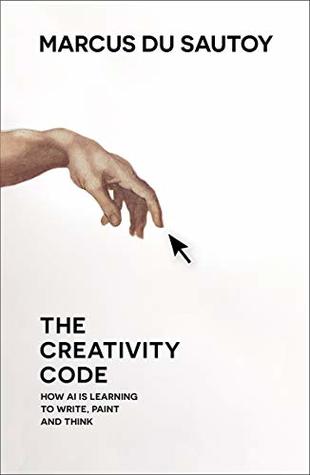
The award-winning author of The Music of the Primesexplores the future of creativity and how machine learning will disrupt, enrich, and transform our understanding of what it means to be human.
Can a well-programmed machine do anything a human can―only better? Complex algorithms are choosing our music, picking our partners, and driving our investments. They can navigate more data than a doctor or lawyer and act with greater precision. For many years we’ve taken solace in the notion that they can’t create. But now that algorithms can learn and adapt, does the future of creativity belong to machines, too?
It is hard to imagine a better guide to the bewildering world of artificial intelligence than Marcus du Sautoy, a celebrated Oxford mathematician whose work on symmetry in the ninth dimension has taken him to the vertiginous edge of mathematical understanding. In The Creativity Code he considers what machine learning means for the future of creativity. The Pollockizer can produce drip paintings in the style of Jackson Pollock, Botnik spins off fanciful (if improbable) scenes inspired by J. K. Rowling, and the music-composing algorithm Emmy managed to fool a panel of Bach experts. But do these programs just mimic, or do they have what it takes to create? Du Sautoy argues that to answer this question, we need to understand how the algorithms that drive them work―and this brings him back to his own subject of mathematics, with its puzzles, constraints, and enticing possibilities.
While most recent books on AI focus on the future of work, The Creativity Code moves us to the forefront of creative new technologies and offers a more positive and unexpected vision of our future cohabitation with machines. It challenges us to reconsider what it means to be human―and to crack the creativity code.
Mark Dawson discusses self publishing as a guest on BBC Radio 4’s Moneybox (Feb 20th 2019)
Mark Dawson has worked as a lawyer and in the London film industry. His first books, The Art of Falling Apart and Subpoena Colada, have been published in multiple languages. He is currently writing three series. The John Milton series features a disgruntled assassin who aims to help people make amends for the things that he has done. The Beatrix Rose series features the headlong fight for justice of a wronged mother–who happens to be an assassin–against the six names on her Kill List. Soho Noir is set in the West End of London between 1940 and 1970. The first book in the series, The Black Mile, deals with the (real-life but little-known) serial killer who operated in the area during the Blitz. The Imposter traces the journey of a criminal family through the period; it has been compared to The Sopranos in austerity London. Mark lives in Wiltshire with his family.
7 Billion Readers and How to Reach Them (The Self Publishing Show, episode 156)
From the Self Publishing Formula
Options for authors are increasing all the time. James talks to Kinga Jentetics about PublishDrive, an aggregator that can distribute books globally, including growing English markets like China and India.
Highlights on this episode:
On the idea for building a global platform to distribute books
How PublishDrive supports authors with tools and information about book sales
How PublishDrive works with the online retailers to promote authors
On the two types of authors who use PublishDrive
International book distribution including China and India














 The Writing Train: Join the locomotion