
IT’S TELEVISION TUESDAY

Keeping It Clean With Post-Apocalyptic Fiction (The Self Publishing Show, episode 178)
SelfPublishingformula.com




Toby Neal was raised on Kauai in Hawaii. She wrote and illustrated her first story at age 5. After initially majoring in journalism, she eventually settled on mental health as a career and loves her work, saying, “I’m endlessly fascinated with people’s stories.”
Toby credits her counseling background in adding depth to her characters–from the villains to Lei Texeira, the courageous and vulnerable heroine in the Lei Crime Series, to the wounds and psychological implications of the heroes of the Scorch Series.



Want to write a crime-fiction story but not sure where to start? Are you between drafts and feeling stuck? Do you feel that you just don’t know enough about police work to write a believable police detective protagonist?
In this conversational and fact-filled handbook, veteran police detective Adam Richardson answers the criminal investigation questions most frequently asked by authors and screenwriters. Unlike many other writing guides about “the cop stuff,” the Writer’s Detective Handbook addresses police procedure and criminal investigation from the storyteller’s perspective.
The Writer’s Detective Handbook: Criminal Investigation for Authors and Screenwriters equips storytellers with the ability to tell a great story while keeping the police-work aspects believable. Reading this book will empower you to write the crime-fiction story you’ve been dying to tell!


I can’t say that setting is any more or less important to historical fiction than any other genre as every genre has its conventions. What makes or breaks a novel is how deft an author is at conveying the expected milieu. In that, historical fiction can be unforgiving. Readers who love this genre already know their history. Beware the author who doesn’t check her facts for she will suffer the slings and arrows of critics who remind her that sycamores are an American tree and potatoes come from the New World. For the record, neither of those were my errors but I have heard from readers protesting facts that in other genres would be deemed unworthy of comment.
In historical fiction it’s not enough to be comfortable with the details of your chosen time period. You also have to get that information from your brain through your fingers and into the book in a way that doesn’t stop the flow. For me that requires writing out all the details I think I’ll need for a particular scene, say a meal in a merchant’s house. How many tables are there and how are they set? What’s on the floor? Where are the windows, if there are windows? Is there a newfangled chimney or is there a central hearth? What colors/designs are painted on the walls? What
furniture might there be besides the tables? Is there crockery? How does it smell? What sounds fill the air from nearby homes or their own workshops? Are they close enough to hear the bells from the nearest church? Are there regraters outside in the street selling goods? Is the neighboring merchant shouting out to passers-by about his wares?
Once I’ve answered those questions, I go back and tighten, tighten, tighten, eliminating this, shortening that, until there are just enough details to describe the scene without slowing the action. This is very hard to do for someone who writes history textbooks disguised as novels to educate unsuspecting readers. I want to share every cool fact I’ve learned. To protect my readers, I employ this mantra: “If I love it, take it out.”
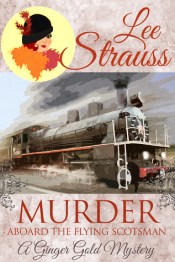

I would say very. The historical backdrop is almost like a character in itself. Readers love the details and historical trivia. Otherwise, you might as well stick to a contemporary setting.

Rhys: for me setting drives many of my stories. NAUGHTY IN NICE. TIME OF FOG AND FIRE. Etc etc
And it’s important to get every detail right. I read biographies, accounts of battles, diaries, study old maps.


What if you no longer had to worry that social media marketing would take hours, leaving you with less time to focus on your writing?
Social Media in 30 Minutes a Day provides a formula that authors can follow to help them save time online without losing their effectiveness or impact.
In just eleven chapters, Frances Caballo helps writers:
implement the same four-step formula that she uses every day
understand the new formula for saving time online
learn how to become a more effective and efficient marketer
learn about hashtags, buzz words, and social media’s lexicon
discover apps that can help writers save time while using social media
use the best tips and best practices you need to know to successfully market your book and blog
If you’ve avoided social media because you felt that you didn’t have enough time for it, you’ve used it sporadically, or you’ve been frustrated by how much time social media networking takes, this book is for you.
Once you read this book, you’ll never waste time online again.

She’s written several social media books including The Author’s Guide to Goodreads, Social Media Just for Writers, and Social Media in 30 Minutes a Day. Her focus is on helping authors surmount the barriers that keep them from flourishing online, building their platform, finding new readers, and selling more books. Her clients include authors of every genre and writers’ conferences. Not sure how you’re doing online? Sign up for her free email course at www.SocialMediaJustforWriters.com


By Fred Waitzkin
Young writers often ask if I am sometimes afflicted by writer’s block and if I’ve discovered a cure. Most writers wrestle with this malady from time to time. Over the years my relationship to the illness has evolved, and as an older writer I see it as a frustrating companion who at times can offer profound advice.
All authors relish days feeling on fire with a story when sentences pour out, almost without effort or thought. They spill into paragraphs and pages. It feels like riding a magic carpet that will soar on forever. I call such periods, writing within the bubble. But then after days or weeks, inevitably, life gets in the way.
Consider this scenario: I’m just home from a ten-day fishing trip, determined to get back to my manuscript when my grandson Jack begs me to take him to tomorrow’s Mets game. Instead of going to my office I take Jack to the game. We’re both excited as hell about our trip on the subway…. It’s okay. I’d been on a roll with my story. Another day won’t matter at all. As we rumble toward Mets stadium, I pleasantly recall the feeling of riding the carpet, the story pouring out of me…. I’ll be back there tomorrow.
The Mets lose. Jack cries, inconsolable in his new Mets cap as we’re leaving the stadium. “Why do the Mets always lose, Baba?”
I’m thinking about Jack’s sorrow and the Mets string of losing seasons. I’m disgusted with the Mets, a thickening edifice forming between me and my story.
Next morning I’m finally back in front of my computer after an eleven-day break. I take a look at my last chapter…. Pretty good. I sit at the computer waiting for the words to flow…. Nothing. I wait. Nothing. Four more days pass of nothing. I’m pulling what’s left of my hair. Now I’m living outside the bubble.
Okay, seven days of writer’s block. I’m back in my office at 9:30. I make a cup of tea. I pace around a little. I have a lunch date at 12:30. I’m looking forward to that. I stare at my Mac like it’s the enemy. I begin to pace around. I sip tea. I look at my computer. No way I’m sitting there to suffer any more. I snap on my old radio and listen to sports talk radio, a discussion about the Mets falling apart after a promising start to the season. Every year they do it. They cannot hit…. It’s now 11. I look at the computer, shake my head, no way. I pace in the hall. I come back into the office and read the paper. Now it’s 11:50. Almost time to leave for lunch. Not yet, Waitzkin, not yet. I stall another five minutes, pressure building. It’s twelve. Suddenly I throw myself into my chair in front of the keys. I need to leave my office for lunch in 18 minutes. It’s now or never…, and if I’m lucky, the dam breaks. Words pour out. I’m feverishly typing words that wouldn’t come for days. They are gushing out now when I hardly have time to write them, trying to catch them in the air like butterflies, get them into the machine… I’ve written some of my best paragraph this way, when it was do or die.
Another trick for writer’s block: I always carry around a tiny notebook in my shirt pocket. When I’m riding my bike home along the river, thinking about the Mets losing streak, an idea pops into my head. I stop the bike and jot it into the book. I’m talking to my wife Bonnie and an idea suddenly appears. I’m talking to my son. He shakes his head, annoyed, while I scrawl treasure into my notebook. “Dad never listens to me.”
Two days ago, I was stumped how to end an essay about my artist mother. I woke up after a two-hour nap and suddenly I could see the words hanging in the air in front of me. I wrote them in the notebook before they disappeared…. Carry a notebook. Just having it with you elicits ideas.
I wrote my new novel, Deep Water Blues, without once having writer’s block. It was pure bliss, beginning to end. I’d decided I was going to write a short book, 150 pages or less, something I could hold in my head without having to turn back to see what I’d written two or three years earlier. I was determined to write this one fast. And also, I’d gone into it after having written a screenplay, my first. I wanted this new book to move like a movie.
Deep Water Blues describes a gruesome disaster that takes place to a little island civilization—an island once gorgeous, and peaceful, almost Eden like, and in the aftermath, the island becomes decimated by greed, out-of-control ambition, violence and murder. At the heart of it, Deep Water Blues, which was inspired by true events, is an adventure story. I wanted to tell the story fast, fast and violent with no looking back, no flashbacks, mostly taut bold scenes as in riveting film…. Writing this book took me over like a runaway train.
There was no room for writer’s block in my new book. Pace and length and a harrowing story were the key elements. Maybe I’ll try that again.
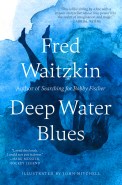
Inspired by a true story, artfully told by the author of Searching for Bobby Fischer: A Bahamian island becomes a battleground for a savage private war.
Charismatic expat Bobby Little built his own funky version of paradise on the remote island of Rum Cay, a place where ambitious sport fishermen docked their yachts for fine French cuisine and crowded the bar to boast of big blue marlin catches while Bobby refilled their cognac on the house. Larger than life, Bobby was really the main attraction: a visionary entrepreneur, expert archer, reef surfer, bush pilot, master chef, seductive conversationalist.
But after tragedy shatters the tranquility of Bobby’s marina, tourists stop visiting and simmering jealousies flare among island residents. And when a cruel, different kind of self-made entrepreneur challenges Bobby for control of the docks, all hell breaks loose. As the cobalt blue Bahamian waters run red with blood, the man who made Rum Cay his home will be lucky if he gets off the island alive . . .
When the Ebb Tide cruises four hundred miles southeast from Fort Lauderdale to Rum Cay, its captain finds the Bahamian island paradise he so fondly remembers drastically altered. Shoal covers the marina entrance, the beaches are deserted, and on shore there is a small cemetery with headstones overturned and bones sticking up through the sand. What happened to Bobby’s paradise?
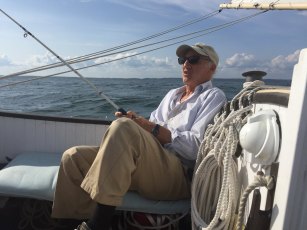
Fred Waitzkin was born in Cambridge, Massachusetts, in 1943. When he was a teenager he wavered between wanting to spend his life as a fisherman, Afro Cuban drummer or novelist. He went to Kenyon College and did graduate study at New York University. His work has appeared in Esquire, New York magazine, the New York Times Sunday Magazine, the New York Times Book Review, Outside, Sports Illustrated, Forbes, the Huffington Post, and the Daily Beast, among other publications. His memoir, Searching for Bobby Fischer, was made into a major motion picture released in 1993. His other books are Mortal Games, The Last Marlin, and The Dream Merchant. Recently, he has completed an original screenplay, The Rave. Waitzkin lives in Manhattan with his wife, Bonnie, and has two children, Josh and Katya, and two grandsons, Jack and Charlie. He spends as much time as possible on the bridge of his old boat, The Ebb Tide, trolling baits off distant islands with his family. His novel, Deep Water Blues, will be published in spring 2019. You can find more on Fred Waitzkin at his website or check out some exclusive content on Facebook.


Resources mentioned in this episode:
PATREON: Self Publishing Formula Show’s Patreon page
SURVEY: Give us your opinions about a possible live SPF event in 2020
From selfpublishingformula.com




Geoff Symon is a 20-year Federal Forensic Investigator and Polygraph Examiner. His participation in high-profile cases includes the attacks on September 11, 2001, the War in Iraq, the Space Shuttle Columbia explosion, the 2002 bombings in Bali and the Chandra Levy investigation, among countless other cases.
He has direct, first-hand experience investigating cases including murder (of all types), suicide, arson, kidnapping, bombings, sexual assault, child exploitation, theft and financial crimes. He has specified and certified training in the collection and preservation of evidence, blood-spatter analysis, autopsies and laboratory techniques. You can reach him at GeoffSymon.com.
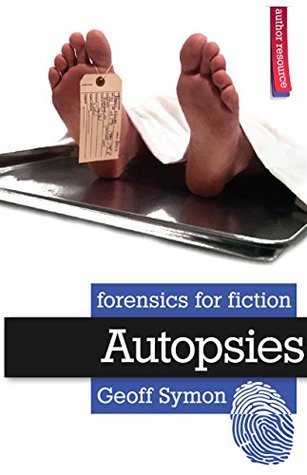
Want to add an autopsy that won’t kill your story? Death swings its scythe in every genre, from family funerals to crime scenes to creatures that won’t stay buried. This user-friendly, illustrated reference digs into all things posthumous and postmortem.
Presented as a research manual for the experienced writer, this “Forensics for Fiction” title offers practical approaches and realistic details by covering:
¤ Terms and techniques used during autopsy procedures
¤ Different postmortem professionals and their specialties
¤ The stages of decomposition in different environments
¤ Methods used to estimate the time of death
¤ Case studies in which autopsies cracked the crime
¤ Examples of how to use autopsies in any popular genre
Whether you’re writing about dissection or resurrection, this guidebook covers it all from cadaver to slab as an easy-to-understand resource for dead-on storytelling.


Sam returns home from a business trip a day before his son’s thirteenth birthday and is looking forward to being with his family, when his world is cruelly shattered in one fell swoop. Initially he thinks he can cope with the loss, but finally seeks the help of Cynthia, an experienced therapist, to regain his equipoise. What he does not know is that Cynthia herself is trying to cope with a debilitating divorce and the sinister shadow of her ex-husband over her daughter…
What happens when doctor and patient find themselves in the same sinking boat? Moreover, when they are rowing in opposite directions–one clinging to the past, and the other unable to get rid of it! In the midst of it all is Lily, Cynthia’s daughter, who harbours a secret that has the power to explode the lives around her.

Dark Blossom. I love the title of this book. Was this your first fiction book? What’s the story behind it? (No pun intended)
Thanks! To be honest, the title appeared to me in a dream. And since I’m being honest, I must also admit that I fell into writing rather serendipitously as well. Dark Blossom is indeed my first work of fiction and both the story and the characters were more or less cleaved by an imagination that had run amok at a time when I was struggling with empathy in my life.
While the characters are all very different from me and the ordeals faced by them are exaggerations of what I was going through, my innate spirit wanted to describe their experiences and interactions in a way that was entertaining for readers. This duality of finding entertainment and perhaps even levity in daily strife exists in everyone including my characters and the title from my dream captured that essence. Here’s a snippet from my book launch on that topic: https://www.youtube.com/watch?v=iodpyiw4Z7Y&t=3s
What do you enjoy most about storytelling?
Given how and when I fell into storytelling, I soon found writing to be an unbridled expression of empathy. First, I needed it for my characters to allow them a full and vibrant range of expression and then, for my readers to help them partake of such expression in a riveting way. So writing afforded me a double dose of empathy if you will – and it helped fill that personal void in my life too.
In retrospect though, there is one other thing about writing and storytelling that I enjoyed as much. Call me a masochist, but I fell in love with playing around with language – its syntax, semantics, and subtleties, all of it! How a word here instead of there, a moved punctuation, or a replaced synonym can affect the way people understand intellectually and perceive viscerally is all very fascinating. As a life-long learner too, I think I have fallen in love with this process of reflection followed by articulation.
Which came first idea, theme, or character?
If I were to think about just the idea and the characters, I would have to say it’s a judicious mix. In order for a story to take place, not only must the idea be important to the characters but also they must have something important to say about it. Once this scaffolding is in place, then the idea might change less and the theme is driven by its interplay with the characters, but it’s the characters that really have to evolve the most. They have to – to fight increasing stakes, win small battles, and eventually come out on top at the end of the war!
What’s your method for character creation?
Good stories take place at the intersection of personal authenticity and people’s perceptions. Ergo, good characters must be borne from a place of sincerity. If that’s not the case, then it will be difficult to convince readers. Once I am able to make this genuine empathic connection with my characters, I follow a five-step process to give them substance – Read, Research, Reflect, Rest, and Repeat. First, I read and research a lot and this includes conversations with people who might provide inspiration. Then I let it percolate by backing off completely after a period of reflection, of course. Lastly, I find myself having to go back to the start of the loop at times when I get stuck.
What can you tell us about Sam?
Phew! Now that’s a toughie. Let me explain. Part of the inspiration behind the novel is my belief that the solution to a rapidly fracturing world lies in peeling enough layers to discover the similarities, rather than judging on mere superficialities. And Sam’s character is supposed to catalyze readers to reflect on how we judge the motives of those around us. In fact, I have even incentivized such reflection with a contest at www.WinTrip2NY.com.
So while Sam’s loss and his tribulations are real, his characterization has been somewhat abstract. Let it suffice to say that he is an immigrant who has assimilated well and is unsure about how to cope with a very deep loss.
Who is Cynthia and what role does she play in the story?
Cynthia is a psychologist and she finds herself alone with her patient and her daughter in a sinking boat. Moreover, they all seem to be rowing away from one another. While trying to heal from a debilitating divorce, Cynthia is helping her patient, Sam, who is struggling with the worst kind of loss there is. She is also trying to mend her relationship with her daughter, Lily, who is not only fighting her own demons but also holding on to a secret that has the power to explode the lives around her.
What was your experience writing the point of view?
From the very beginning, I wanted to narrate the story from Cynthia’s perspective. This was daunting since I am neither a woman psychologist nor do I share a cultural background with her. So I knew I was trying to fill shoes much larger than my own and I had to both step out of my comfort zone and dig deep. And I’d like to believe that I have grown much as a person because of it. So not only was the process personally gratifying but also her perspective turned out to be most relevant for the plot.
Was it easy writing about flawed characters?
Aren’t we all?! But yes, confronting these flaws, let alone embracing or articulating them, is never easy. Fortunately, I strongly believe that such duality exists in all of us and I’m quite comfortable with both my flaws and my struggles with them. Even though writing about these flaws in characters that are different from me wasn’t easy, the fact that I enjoyed this process helped me immensely. Now, as to whether or not I was able to do justice to such expression – I think I’ll let readers be the judge of that.
What’s next for you?
I have only recently started researching and outlining my next novel. It’s also going to be narrated from the perspective of a young woman, Abigail, who has just started her first job as a nanny at a prominent bureaucrat’s home. The story starts with her charge, six-year-old Stewart, fighting for his life in the pool. And Abigail soon discovers that June, the boy’s older sister, may have been the one who pushed him in.

.
Neel Mullick is the author of Dark Blossom. The Head of Product and Information Security at a Belgian family-office technology company, Mullick is a graduate of Carnegie Mellon University and INSEAD. He mentors female entrepreneurs through the Cherie Blaire Foundation for Women, is involved in raising a generation of digital and socially aware leaders with Nigeria’s Steering for Greatness Foundation, supports improvement in the quality of life of domestic workers through Peru’s Emprendedoras del Hogar, and works with IIMPACT in India to help break the cycle of illiteracy plaguing young girls from socially and economically impoverished communities. Dark Blossom is his first novel.
rejuvenatement - not retirement
...a crime-fictional site
Established in May 2011 to help nurture and inspire the poetic spirit.
A place for poems and pics
a simple pairing of pictures and poetry
Sharing Poetry and Hugs
Persistent WV Poet
A.I. Art and Poetry
short writing prompts
I am the way and the reality and the life...John 14:6
Submit your film, screenplay, novel, to the festival and get it showcased at the FEEDBACK Festival. Full Feedback on all entries.
Military Science Fiction Author
 The Writing Train: Join the locomotion